


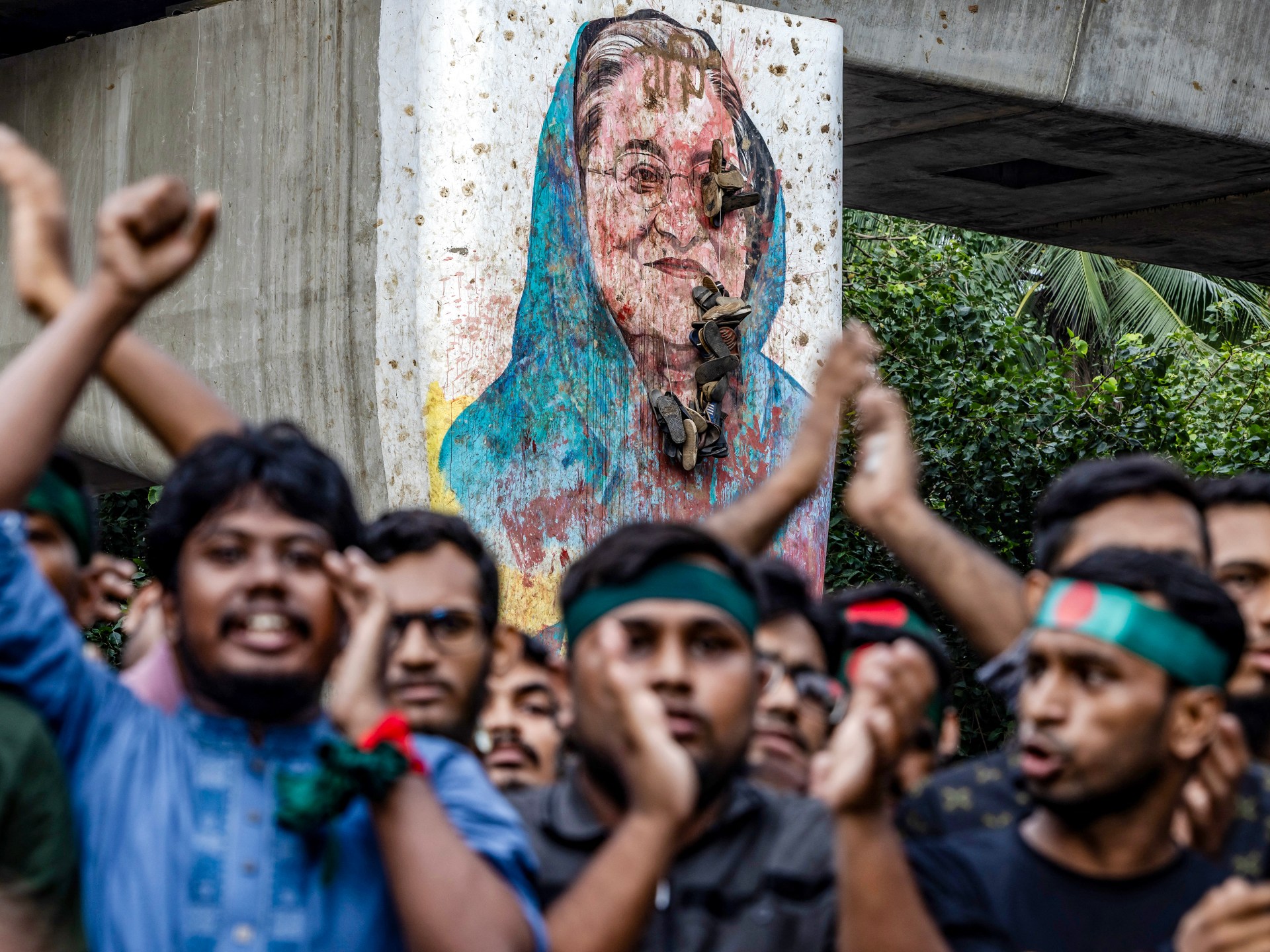
Sheikh Hasina is a convicted fugitive.
Until August 2024, she was the most powerful leader in Bangladesh’s history, after 15 years of iron-fisted rule. On Monday, the 78-year-old former prime minister was handed a death sentence in absentia over the brutal crackdown by her security forces on last year’s student-led protests. More than 1,400 people were killed, many of them execution-style.
Recommended Stories
list of 4 itemsend of list
Hasina, who had fled to neighbouring India after she was forced out of power, has over the past year remained combative and unrepentant. On Monday, she responded to the verdict by the Bangladeshi International Crimes Tribunal (ICT) by acknowledging the deaths of hundreds of innocent people, but refused to take responsibility.
“I mourn all of the deaths that occurred in July and August of last year, on both sides of the political divide,” she said in a statement. “But neither I nor other political leaders ordered the killing of protesters.”
Hasina also called the verdict by the ICT “biased and politically motivated”.
For millions of Bangladeshis, the death sentence awarded to Hasina represents justice, even though India’s likely refusal to extradite the former prime minister means that grieving families that lost loved ones to excesses under her rule will have to wait for closure.
Targeting of political opponents
But for Bangladesh as a country, the verdict could serve as a moment for an even deeper shift if it chooses to now close the loop on the abuse of security forces, courts and other institutions of the state to target opponents and critics – practices that Hasina perpetuated and came to represent.
Hasina’s claims that she is the victim of political persecution mirror the allegations that her government faced during the decade-and-a-half of its rule.
The ICT was established by Hasina herself in 2010 to prosecute Bangladeshis accused of collaborating with Pakistan in carrying out atrocities during the 1971 liberation war.
Now the same tribunal has convicted her.
For years, human rights groups have accused her of using the tribunal together with government institutions, including courts and the security establishment, to punish her political opponents.
Her main political rival – Khaleda Zia, who was Bangladesh’s first female head of government – was jailed under corruption charges while the country’s largest Islamist party, the Jamaat-e-Islami, was barred from contesting elections and subsequently banned under an “anti-terror” law.
Zia was released only after the interim government of Nobel laureate Muhammad Yunus came to power last year, following Hasina’s ouster.
Yunus himself was convicted in January 2024 on charges of labour law violations that many say were politically motivated. He was sentenced to six years in prison, but got bail. The economist had been in Hasina’s crosshairs after he floated the idea of launching a political party in 2007. Grameen Bank, established by Yunus, pioneered the concept of microloans, which helped empower millions of rural women.
Hasina and her Awami League party have long worn the badge of secularism. But during her rule between 2009 and 2024, they were accused of weaponising secularism to justify targeting Islamist parties and dissenters. An entire generation of Jamaat leaders was executed based on convictions issued by the ICT.
Writing in the Bangladeshi newspaper The Daily Star on Monday, analyst Arman Ahmed said that the Awami League “transformed secularism from an ideal of freedom into a rhetoric of control”.
“It came to be associated with censorship, patronage, and the systematic weakening of any political opposition. When power became synonymous with a single party, the moral authority of its secular project collapsed,” he wrote.
Hasina’s autocratic rule was particularly marked by grave human rights violations. Between 2009 and 2022, at least 2,597 people were killed by the security forces extrajudicially, according to human rights groups.
In 2021, the United States imposed sanctions against the police counterterrorism unit, Rapid Action Battalion (RAB), accused of involvement in hundreds of enforced disappearances and extrajudicial killings.
Odhikar, a prominent rights group, was also targeted after it criticised the government for granting impunity to security forces for human rights violations. In 2023, two of its founders were jailed.
Famed Bangladeshi photographer and activist Shahidul Alam was jailed in 2018 after he criticised Hasina’s government for widespread “extrajudicial killings”, in an interview with Al Jazeera.
When the protests against government job quotas erupted last July, Hasina deployed riot police instead of engaging in talks with the stakeholders.
She ordered the security forces to use drones, helicopters and lethal weapons to suppress the protests, according to Bangladeshi media.
But the brutal crackdown, including the arrest of thousands, galvanised a mass movement against her government, triggering her downfall.

Hasina’s legacy – and why Bangladesh must break with it
Now, Hasina’s political future in Bangladesh is over.
What remains is her legacy.
To be sure, she led a decade-long struggle to revive democracy in the 1980s, teaming up with rival Zia to force the country’s then-military ruler, President Hussain Muhammad Ershad, to relinquish power. Zia’s BNP won the 1991 election. Hasina then defeated Zia in the 1996 elections to become prime minister for the first time, as their political rivalry turned increasingly bitter.
After Hasina returned to power in 2009, she addressed the country’s security challenges, cracking down on armed groups and providing stability.
She also led an economic resurgence. In a country that former US Secretary of State Henry Kissinger once described as a “basket case”, millions were lifted out of poverty under Hasina. Bangladesh’s per capita income surpassed neighbouring India, while its gross domestic product (GDP) of $430bn is bigger than Pakistan’s – the country it broke away from 54 years ago. Today, Bangladesh is the world’s second-largest garment exporter, after China.
But critics point out that growth under Hasina was not equitable, with the country’s wealthy class benefitting from her economic policies. She was also accused of favouring an Indian businessman over the interests of Bangladesh.
And the economic strides that Bangladesh took were accompanied by human rights violations, arbitrary arrests, muzzling of the press, silencing of the opposition and the hollowing out of the country’s democratic institutions.
The BNP, the main opposition party, boycotted the 2014 elections after Hasina refused to appoint a neutral caretaker government to conduct the vote.
Hasina won the next election held in 2018, garnering 96 percent of the votes. Ahead of the elections, Zia was barred from contesting over her convictions, while dozens of BNP candidates were arrested, drawing serious questions about the credibility of the vote.
An analyst at the time described Hasina’s rule as “development minus democracy”.
Hasina’s government repeated that pattern ahead of the 2024 election: opposition parties were attacked, and leaders were arrested ahead of the polls. The BNP boycotted as a result, turning the election into a no-contest.
After the victory, Hasina hardened her position, calling the BNP a ‘terrorist’ organisation.
But the tables turned – in October 2024, two months after she fled to India, the interim government banned Chhatra League, the student wing of the Awami League, describing it as a “terrorist organisation”.
Now, as Bangladesh prepares for its first post-Hasina election on February 2026, it faces a test. In May, the Yunus government banned the Awami League from all political activity, and as things stand, Hasina’s party will not be able to compete in the upcoming election.
That is a major setback for the democratic rights of millions of Bangladeshis, who still support the Awami League.
The step emulates the mistakes of previous governments, which chose retribution over reconciliation.
Meanwhile, extrajudicial killings and enforced disappearances – a feature of Hasina’s rule – continue under the new government.
Convicting Hasina and sentencing her for her crimes is a critical step towards justice. But Bangladesh can truly move forward from the pain and trauma her government inflicted on the nation only if it breaks with the worst parts of her legacy — by building democratic institutions that are inclusive, genuinely participative, and crucially, non-vindictive.
