


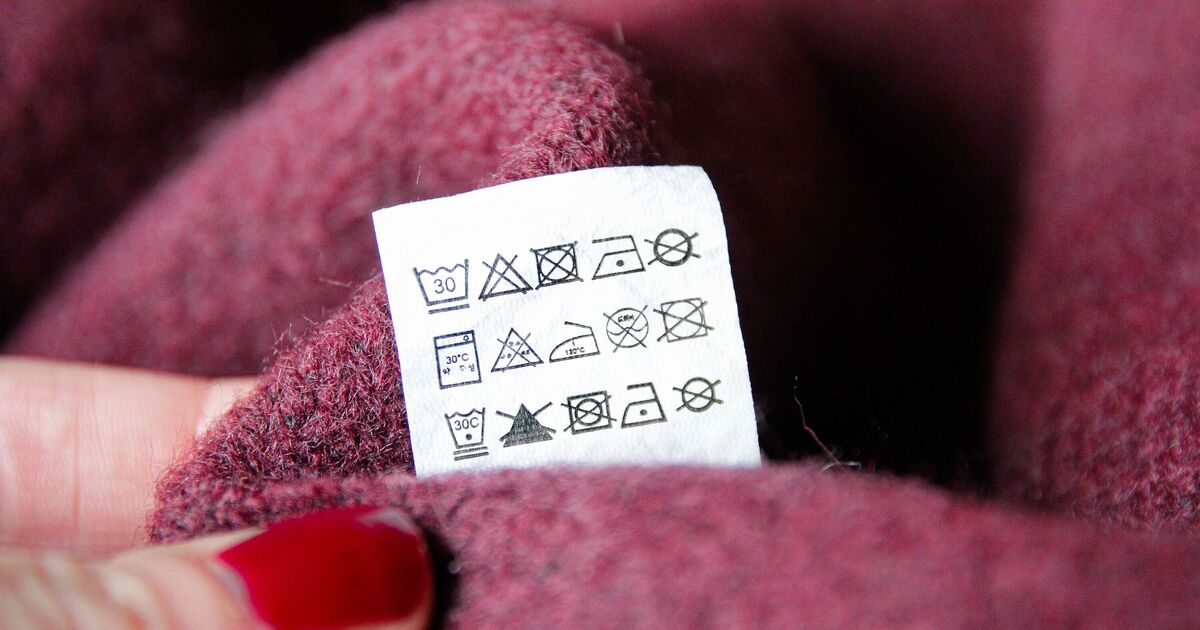
Sorting through your laundry is a daily task for many, but have you ever taken the time to understand the symbols on your clothing labels? Each garment can have up to five key symbols, yet most people are clueless about their meanings. This lack of knowledge could potentially damage your favourite clothes and reduce their lifespan with each wash.
Some symbols, like the bucket of water with a temperature inside, are relatively straightforward, indicating the maximum temperature at which the item can be safely washed without causing harm. However, the meaning of the triangle symbol on clothing labels remains a mystery to many, despite its presence on countless garments.
The white triangle on clothing labels can appear in four variations: an empty triangle, a triangle crossed out, a triangle with two diagonal lines, or a triangle containing ‘CL’ with a line through it. These symbols all relate to the use of bleach. An empty triangle signifies that the item can be bleached.
A crossed-out triangle indicates that the item should not be bleached. A triangle with two diagonal lines or a triangle with ‘CL’ and a cross through it suggests the use of non-chlorine bleach.
Salah Sun, Head of Product Marketing at Beko Plc UK and Ireland, explains: “Throwing a pile of laundry in your washing machine isn’t uncommon; we’ve all done a quick drum dash without looking to see what we’re putting inside, but this can damage your clothes.
“Everything you need to know about your clothes is on their labels. Knowing your symbols and clothing inside out can help you avoid laundry mishaps and keep your favourite clothes lasting longer.”
Washing
The washing symbol typically appears first on your care label. It’s easily recognisable as it resembles a water-filled tub. Picture this as your conventional washing drum. Within the water illustration, you may spot various markings. Based on what appears inside the water symbol, you’ll need to launder your items at specific temperatures.
The figures correspond directly to the temperature required on your washing machine, making sorting laundry by heat setting an effective method for organising your wash cycles. Should your symbol display dots instead of numbers, you can still determine the correct temperature for your garments.
A single dot indicates 30 degrees Celsius, whilst six dots represent 95 degrees. Salah notes: “Washing your clothes at the right temperature is important for the long-lasting quality of your favourite items. Following the care label instructions can keep your outfit looking new and lasting longer, getting you more wear for your money.”
Your laundry symbol might feature a hand, signifying hand-wash only, whilst a crossed-out version means the item cannot be machine washed. Should you spot a line beneath your washing symbol, you can machine wash and tumble dry on a permanent press setting, whereas two lines suggest a delicate machine wash cycle.
Ironing
The ironing symbol is easily recognisable as it’s shaped precisely like an iron. Only six variations of the ironing symbol appear on garment labels, helping you determine the optimal methods for keeping your clothes wrinkle-free. A plain iron symbol simply indicates that you can iron your clothing. This appears on most garments.
Nevertheless, certain fabrics don’t respond well to pressure or heat, so an iron symbol with a cross means you mustn’t iron these pieces. You may also encounter an iron with a cross beneath it. This signifies you shouldn’t steam your garment, though ironing without steam is acceptable.
Similar to the washing symbol, your iron symbol can also specify the temperature level you should employ. This symbol utilises the dot system. One dot within your iron symbol suggests low heat, two dots indicate medium temperature, and three dots recommend high heat.
Salah remarks: “When it comes to chores, ironing isn’t everyone’s favourite. But you could be ironing items you don’t even need to. Check your clothing labels first to ensure you’re not adding unnecessary items to your chore list or damaging your clothing with a too-hot iron.”
Drying
Your drying symbol appears as a square on your garment’s care label. This becomes crucial when determining the optimal drying method for your clothing, particularly if you own a washer-dryer. A plain square signals that you can tumble dry the item on any heat setting without concern.
Salah explains: “There’s a handful of drying symbols you’ll want to know to keep your clothes looking their best. If it isn’t simply an empty square, knowing the right method of drying for your specific clothing is important for the longevity of your clothes. Wool, for example, should typically be air-dried flat to prevent it from shrinking, or on a gentle dry cycle.”
A square featuring a cross indicates ‘do not dry’, whilst a square containing a circle in the centre (resembling a tumble dryer) with a cross means ‘don’t tumble dry’. A square with a solid black circle in the middle signifies ‘tumble dry with no heat’.
Similar to washing symbols, a drying symbol with one line underneath indicates a permanent press setting, whilst two lines suggest using a delicate cycle.
The drying symbol also reveals the correct position for drying your garments. A square containing a horizontal dash in the centre means to dry it flat, as with woollen items, whilst a square with two diagonal lines in the top left corner indicates drying in the shade.
Hang drying is depicted by a square with a semi-circle at the top, resembling a washing line between the two upper corners of the square, whilst drip drying is shown by a square containing three vertical lines inside.
Professional cleaning
The last symbol you may come across is for professional cleaning. This might be an option for pricier suits, larger items, or garments that hold sentimental value. A circle on your care label signifies professional cleaning.
Salah concludes: “There are 10 professional cleaning labels that you might come across, but most won’t apply to your home laundry. The most important two for non-professional cleaners are quite self-explanatory and the rest your local dry cleaners will be able to decipher.
“You’ll need to be able to recognise the empty circle, which indicates that the item is fine to be professionally cleaned, while items that cannot be professionally cleaned will be a circle with a cross through it.
“Knowing what your clothes are trying to tell you is important for keeping them looking and feeling as fresh as possible. You don’t want to find out you’ve used the wrong setting and now your favourite wool jumper is misshapen. Instead, separate your laundry based on colours and care symbols to ensure that each item is getting the right care.”
