


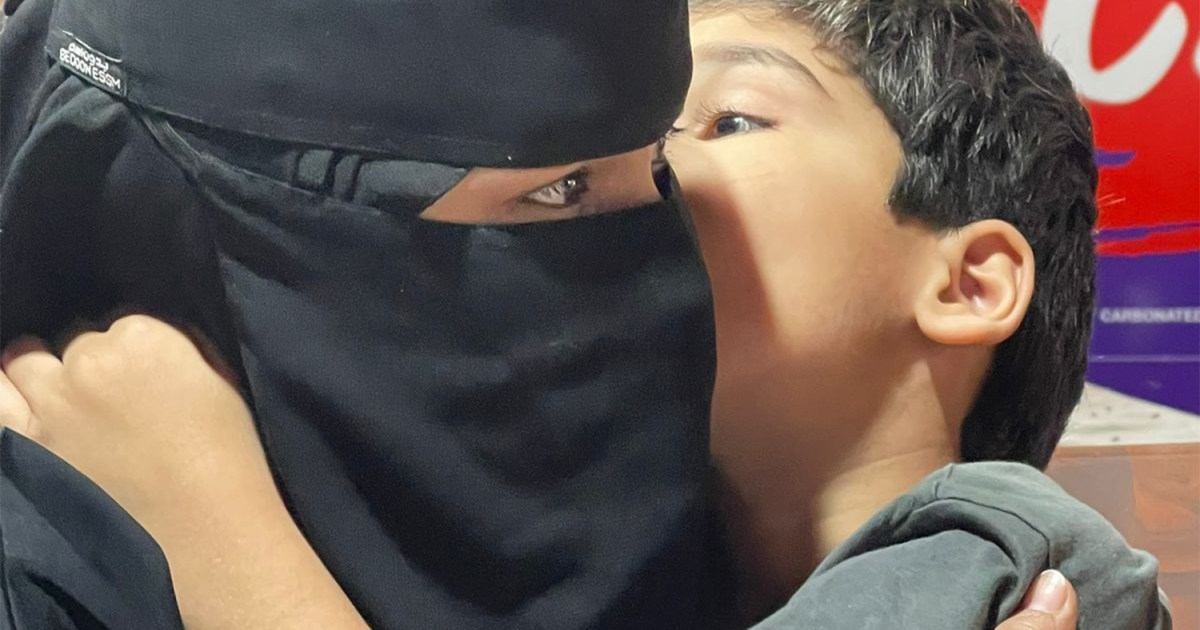
Srinagar, Indian-administered Kashmir – The silence of a narrow alley in Srinagar, the main city of Indian-administered Kashmir, is broken by the rehearsed beckoning of street vendors and the restless cries of two little children.
“Auntie, please take me to my mother; the police took her away,” shouts three-year-old Hussein, as he and his sister Noorie, a year younger than him, cling to the window of their one-room house, their faces pressed against rusted iron bars.
Recommended Stories
list of 4 itemsend of list
Their father, Majid*, says the two have been calling out like that to almost every passer-by since their mother, Samina*, a Pakistani national, was forcibly taken away by Indian authorities and deported more than seven months ago.
The family’s ordeal began a week after half a dozen gunmen, a couple of them alleged to be Pakistani nationals, stormed a scenic tourist spot in Indian-administered Kashmir’s Pahalgam area and shot 26 people dead on April 22, 2025 in one of the worst attacks in the disputed region.
The Muslim-majority region of Kashmir is divided between India and Pakistan, though the nuclear-armed neighbours claim it in full, while regional superpower China also controls a sliver of Kashmir’s land. Since India’s independence from British rule and its partition to create the state of Pakistan in 1947, the two countries have fought two of their three full-scale wars over Kashmir.
In the late 1980s, an armed rebellion against New Delhi’s rule erupted on the Indian side, which has since claimed tens of thousands of lives, most of them civilians. The rebellion saw the deployment of nearly a million Indian soldiers, making it one of the world’s most militarised regions. The rebels aim to either carve an independent nation out of Kashmir or merge the region with Muslim-majority Pakistan.
The anti-India sentiments in Kashmir intensified in 2019 when Prime Minister Narendra Modi’s Hindu majoritarian government scrapped a law that granted the region partial autonomy in matters of land ownership and livelihoods, and split it into two “union territories” to be directly governed by New Delhi. Since then, suspected Kashmiri rebels have launched several attacks against Indian security forces and government employees. India accuses Pakistan of training and financing the rebels, but Islamabad dismisses the charge, claiming it only provides diplomatic backing to Kashmir’s struggle.
India blamed Pakistan for the Pahalgam attack as well, and swiftly moved to downgrade all diplomatic ties, suspend bilateral trade, and place a key water treaty in abeyance. Two weeks after the killings, in early May, India and Pakistan engaged in an intense four-day air war, each striking the other’s military bases. Dozens of people were killed on both sides — India insists it only hit “terrorists” in Pakistan, while Islamabad said civilians were principally the victims — before the neighbours agreed to a ceasefire.
But seven months later, the pause in fighting has meant little for hundreds of families, like Majid’s and Samina’s, that were broken apart by one of India’s moves.
In the aftermath of the Pahalgam attack, India revoked all visas issued to Pakistani citizens residing in India, including medical and diplomatic visas, giving them an April 29, 2025 deadline to leave the country, and closing the Attari-Wagah border in Punjab province’s Amritsar district on May 1.
Nearly 800 Pakistanis – many of them married to Indian nationals in Kashmir and other parts of India – were deported.
With authorities providing no clarity on whether those families will ever be reunited, the wait drags on for relatives on both sides of the border.
‘I think of ending my life’
Majid married Samina, his 38-year-old Pakistani cousin, in 2018.
Despite tense relations between their countries, their marriage was not especially rare. When millions of Muslims moved to a newly-created Pakistan in 1947 – as did Hindus to India – many left behind relatives on both sides of the border. Over the years, these blood ties gave rise to cross-border marriages between citizens of the two countries.
But on April 28, Samina was summoned to the local police station in Srinagar’s Dalgate area. Noorie and Hussein slept on their laps as the couple met the police officer. When the children woke up, they realised their father had brought them back home, their mother no longer around.
Samina was detained at the police station and informed that she would be deported to Pakistan — she is originally from Lahore — the next day.
Sitting quietly in a dimly lit room that served as a bedroom and kitchen, Majid said he is still struggling to process the events that turned his life upside down.

He used to wait tables at a local restaurant and earned about $70 a month. But since his wife was taken away, he has not been able to leave his little children alone. He is now jobless.
“I have not slept properly for six months now. My whole time is spent taking care of the children. I cannot think about doing anything else,” he told Al Jazeera.
Confined to his room, Majid says he is unable to go out even to buy groceries. “Sometimes, I think of ending my life,” he said. “But I stop myself, wondering who would take care of them when I am gone.”
Majid’s children, Hussein and Noorie, also do not know when they will be able to see their mother.
“The sudden separation from Samina has traumatised them. They call out to their mother in sleep,” Majid told Al Jazeera as he made a futile attempt to distract his children by showing them cartoons on his mobile phone.
“All they know is that the police took her away. Whenever they see any police or army officer, they ask them to bring their mother back.”
Meanwhile, forcibly separated from her children, Samina is struggling with health issues in Pakistan. Her blood pressure is unstable due to stress. “She gets hospitalised every now and then. Her blood pressure isn’t normalising,” said Majid.
When asked about the deportations, Shazia Ilmi, spokeswoman for India’s ruling Bharatiya Janata Party (BJP), suggested that the moves were driven by national security concerns. Those deported were Pakistani nationals, she emphasised, and often were “married to those who have been found involved in terrorism and activities that are antinational”, she told Al Jazeera.
“So this cannot become a way for Pakistani nationals to marry into India and support such activities. Why should India have Pakistani nationals?” she said.
When pressed to present evidence in support of her allegation that deportees were often married to those involved in “terrorism”, Ilmi accused Al Jazeera of having a “dubious agenda”. “I think you have a nasty agenda to find things against India and the Indian government, and it will not work,” she said.
Reunited after years, separated again in 12 days
Muhammad Shehbaz is a 32-year-old resident of Daryaganj, a densely populated neighbourhood of what is called Old Delhi. In 2014, he married his maternal cousin from Pakistan, 27-year-old Erum. Since then, Erum had been living in India on a long-term visa until she travelled to Pakistan to introduce their three-year-old son, Almeer, to her family.
That was in March 2020 – just 10 days before a lockdown and travel restrictions were imposed in the wake of the coronavirus pandemic. Erum was forced to extend her stay in Pakistan, during which her Indian visa expired.
After the lockdown was lifted, Shehbaz tried hard to secure another Indian visa so that Erum could return. After five years of repeated rejections, she was finally granted one in April this year. After more than five years of separation, an elated Shehbaz was finally going to be reunited with his family.
Erum reached New Delhi on April 17. Twelve days later, the Pahalgam attack happened. She was deported back to Pakistan on April 29.
“After so many years of separation, hard work and longing, she had finally come home. My world had lit up, and I forgot everything. And then, in the blink of an eye, it all collapsed again. She was taken away, leaving me vulnerable and drowning in despair,” Shehbaz told Al Jazeera.
“When the police came to our home and informed us about Erum’s deportation, I became numb. My son was crying inconsolably. The struggles I faced all these years to reunite my family are beyond words. And now, it feels like it was all in vain.”
Almeer, now nine, first grew up for years without his father and has now been torn away from his mother. Shehbaz, who runs a small jewellery business, is worried about his future.
“He has grown frail and quiet, not expressing much, but I can see he is shattered inside,” Shehbaz told Al Jazeera. “Caught in the animosity between the two countries, why are ordinary citizens pushed to the wall? What is our fault?”
Parveena hadn’t been to Pakistan in 40 years
Back in Indian-administered Kashmir, Fazl‑u‑Rehman, 62, does not know if he might be able to see his wife, Parveena, who was deported in April to Pakistan, a country she had not seen in more than four decades.
Parveena, 65, was born in Pakistan’s Karachi city. But she never went back after marrying Rehman in 1982, as she built a life with her husband and children in Baramulla district.
Rehman now fears he may die without seeing her. “Our home has been divided. Everything is in ruins. I don’t know how many years I will live,” he told Al Jazeera, his voice choking.

Rehman and Parveena have two daughters – the elder one, Afreen, is married, while Soliha, 27, is at home, looking after her ageing parents while also pursuing a master’s degree in political science.
“I missed my second semester mid-term exams in July while managing the household responsibilities alone,” she told Al Jazeera. “I have to do it all alone – getting medicines, groceries and other household chores. Left with no option, I had to sacrifice my education.”
Soliha said her mother has been undergoing treatment for heart disease in Kashmir. But she has no means to continue her treatment in Pakistan, where she has no immediate relatives or financial support. She said her mother lives in Karachi with a distant relative, who is paralysed.
“There is no one to look after her. If anything happens to my mother there, the Indian government would be responsible,” she said.
“If someone else committed the crime, why are we being punished for it? My education and career are at stake. I am facing mental health issues because of my mother’s deportation.”
Her father, Rehman, intervened. “There are 700,000 to 800,000 armed forces in Kashmir. If they couldn’t prevent the [Pahalgam] attack, how are civilians being held responsible for it?” he asked, furiously.
Parveen urged the government to “stop punishing your own citizens” and demanded the return of their loved ones.
‘Never felt so helpless in life’
Abdullah* says he has been forced to rebuild his life that fell apart after his wife, Tamarah*, 25, was deported on April 29. He says his twin toddlers – Ayan and Atif, just 18 months old – no longer play, laugh, or eat as they once did. One of the twins was still breastfeeding when Tamarah was deported.
Abdullah, a 38-year-old public bank manager in Kashmir’s Kupwara district, married Tamarah in 2018. As she was driven to the Attari-Wagah border for deportation, Abdullah took his children and followed the police van in his car all the way from Kupwara to Amritsar, a distance of more than 500km (324 miles).
“I cried on the way, pleading helplessly with the police to at least let the children see their mother one last time,” he told Al Jazeera. “But they didn’t even allow us a proper goodbye.”
The first two months were “nothing short of hell” for the children.
“After the sudden separation from their mother, their health began to deteriorate. They suffered frequent fevers and vomiting,” he said, adding that he has barely attended office in the past six months, with one or the other child needing hospitalisation.
“Everything is disrupted. Life has turned upside down. I have never felt so helpless in my life,” he said.
Abdullah said even lawyers refused to take up the case of his children, separated from their mother. He said the lawyers said no legal action could proceed without permission from the federal Ministry of Home Affairs. In desperation, Abdullah said he wrote to Prime Minister Modi and other authorities in New Delhi and Kashmir, but received no response.
‘Because they are Pakistanis and Muslims’
Human rights activists say there is no justification for penalising innocent civilians due to the tensions between India and Pakistan.
“Ordinary people hold no enmity towards each other. Why should they suffer because of political or diplomatic conflicts?” said Shabnam Hashmi, a New Delhi-based activist. “In any conflict, civilians must never be the casualties. To separate a child from their mother is cruel, traumatic, and utterly inhuman – a clear violation of human rights.”
Waheed Para, a Kashmiri legislator from the Peoples Democratic Party, said the deportation of Pakistani nationals is unjust and unfortunate.
“After Kashmir’s conversion into a union territory, our ability to influence or resolve such issues has been severely limited. We can raise our voices and try to intervene, but we remain largely powerless in the face of decisions made elsewhere,” he told Al Jazeera, referring to the federal government in New Delhi.
“In cross-border shelling, civilians lose lives and homes. Unfortunately, innocent citizens, children, and women continue to be the casualties of a geopolitical issue between India and Pakistan,” Para added.
Al Jazeera reached out to the Ministry of Home Affairs for their response, but did not receive any reply.
Colin Gonsalves, Supreme Court lawyer and rights activist, said the deportation of Pakistani nationals has no legitimate connection to the Pahalgam attack.
“Linking them to Pahalgam [attack] is simply an excuse and a deeply flawed one … The government may claim it is a fallout of Pahalgam, but that claim is not only misleading, it’s dangerous,” he told Al Jazeera.
“They were deported simply because they are Pakistanis and Muslims – a clear reflection of a bias against both.”
Back in Kupwara, Abdullah wipes the tears rolling down his cheeks, struggling to speak as he recollects the months since his wife Tamarah was deported.
“What the Indian government did to us is no different from what the attackers did in Pahalgam. They destroyed our families and homes too,” he said. “Why are our innocent children being punished? What did they do?”
*Names changed to protect their identities over fears of government reprisal.
