


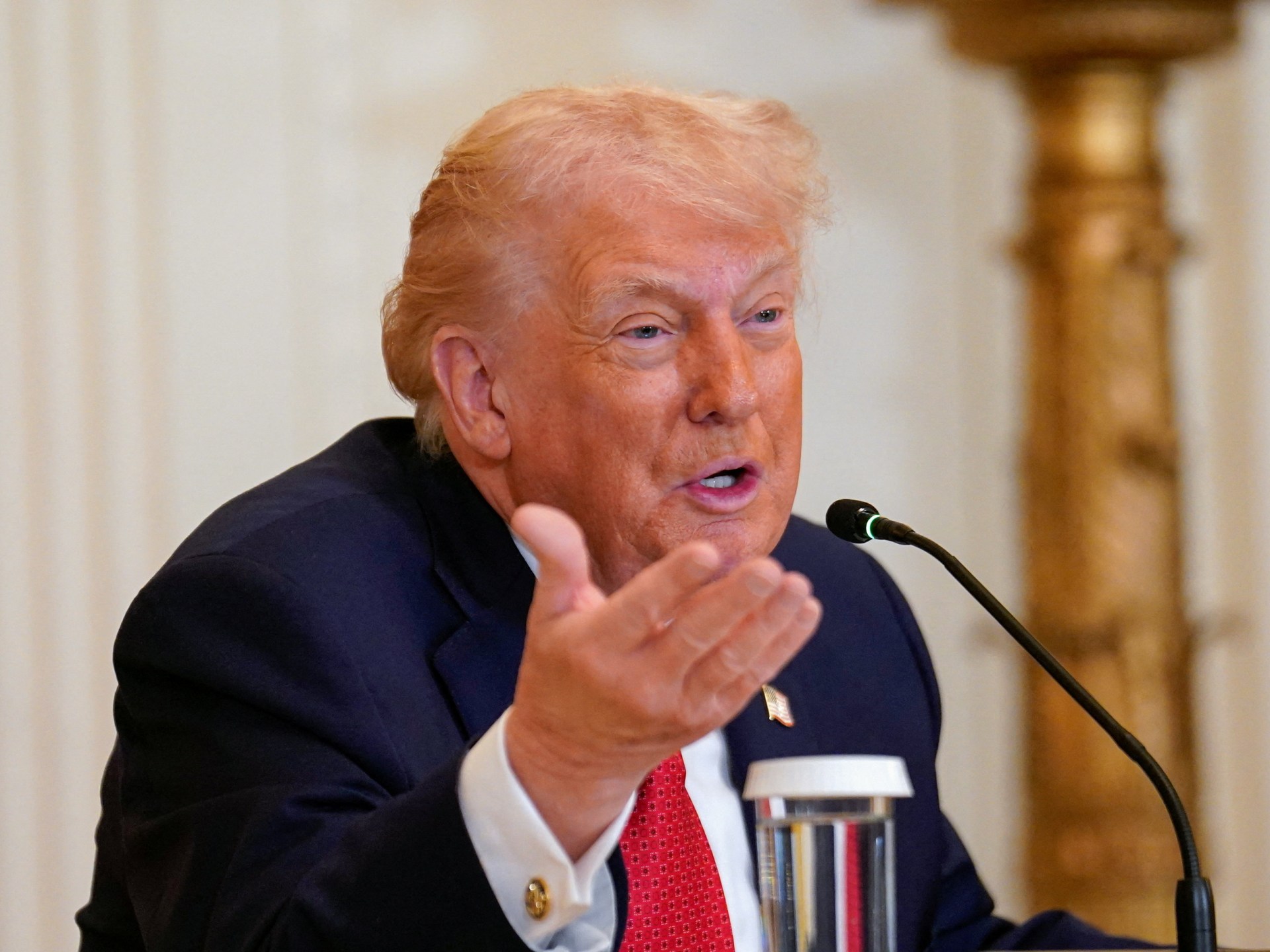
US President Donald Trump says he may impose tariffs on countries that don’t back the United States’s claim to control Greenland, a message that came as a bipartisan congressional delegation sought to lower tensions in the Danish capital.
Since Trump returned to the White House in January, he has repeatedly insisted that the US control Greenland, a semiautonomous territory of NATO ally Denmark, and said earlier this week that anything less than the Arctic island being in US hands would be “unacceptable”.
Recommended Stories
list of 3 itemsend of list
During an unrelated event at the White House about rural healthcare, he recounted on Friday how he had threatened European allies with tariffs on pharmaceuticals.
“I may do that for Greenland too,” Trump said. “I may put a tariff on countries if they don’t go along with Greenland, because we need Greenland for national security. So I may do that,” he said.
Trump has said Greenland is vital to US security because of its strategic location and large supply of minerals, and has not ruled out the use of force to take it, but he had not previously mentioned using tariffs to try to force the issue.
Later, Trump reiterated his reasons for wanting to control Greenland and said he was in talks with NATO about the island.
“We need Greenland for national security very badly. If we don’t have it, we have a big hole in national security, especially when it comes to what we’re doing in terms of the Golden Dome,” he told reporters.
Eyes on Russia
The head of Denmark’s Joint Arctic Command in Greenland told Reuters on Friday he is focused on countering potential Russian activity, not defending against US military threats.
“My focus is not toward the US, not at all. My focus is on Russia,” Major General Soren Andersen said on board a Danish warship in Nuuk, Greenland’s capital.
Andersen dismissed suggestions of conflict between NATO allies, describing such a scenario as “hypothetical”.
“I don’t see a NATO ally attacking another NATO ally,” he said. Referring to Denmark’s defence plans, he added, “We work on those, but it’s a normal thing for us to do. My task is to work up here for the defence of the kingdom together with NATO.”
In response to US concerns, European nations dispatched small numbers of military personnel to Greenland this week in preparation for the Arctic Endurance NATO military exercise.
The Arctic Command has invited the US to participate in Arctic Endurance, which this year will test forces in winter conditions.
“We had a meeting today with a lot of NATO partners, including the US, and invited them to participate in this exercise,” Andersen said, adding that he did not yet know whether the US would also join. Denmark did not invite the Americans to join a similar exercise in September.
Denmark’s Joint Arctic Command, responsible for defence around Greenland and the Faroe Islands, conducts surveillance and search-and-rescue missions, utilising patrol vessels, aircraft, helicopters, and satellite technology. It also fields the Sirius dog-sledge patrol for long-range Arctic operations.
Andersen said there were no Chinese or Russian ships near Greenland, though he added that a Russian research vessel was located 310 nautical miles away. “That’s the closest one,” he said, adding that NATO allies maintain “a good picture of the situation up here”.
“We actually expect an increase in Russian activities in the coming years, and… we have to start training and increase the presence here in the Arctic to protect NATO’s northern border,” Andersen said.
Sharply diverging views
Earlier this week, the foreign ministers of Denmark and Greenland met in Washington with US Vice President JD Vance and Secretary of State Marco Rubio.
That encounter didn’t resolve the big differences, but did produce an agreement to set up a working group — on whose purpose Denmark and the White House then offered sharply diverging public views.
European leaders have insisted that only Denmark and Greenland can decide matters concerning the territory, and Denmark said this week that it was increasing its military presence in Greenland in cooperation with allies.
A bipartisan delegation of US lawmakers met the leaders of Denmark and Greenland in Copenhagen on Friday, seeking to “lower the temperature” with assurances of congressional support to recognise Greenland as an ally, not property, after Trump’s threats to seize the Arctic island.
European nations this week sent small numbers of military personnel to the island at Denmark’s request.
The 11-member US delegation, led by Democratic Senator Chris Coons, met Danish Prime Minister Mette Frederiksen and her Greenlandic counterpart Jens-Frederik Nielsen, as well as Danish and Greenlandic parliamentarians.
“There’s a lot of rhetoric, but there’s not a lot of reality in the current discussion in Washington,” Coons told reporters following the meetings, saying the politicians would seek to “lower the temperature” on returning home.
Looking for a deal
Trump’s special envoy to Greenland also said on Friday he plans to visit the Danish territory in March and believes a deal can be made.
“I do believe that there’s a deal that should and will be made once this plays out,” Jeff Landry told Fox News in an interview on Friday, as the US delegation met the Danish and Greenlandic leaders.
“The president is serious. I think he’s laid the markers down. He’s told Denmark what he’s looking for, and now it’s a matter of having Secretary [of State Marco] Rubio and Vice President JD Vance make a deal.”
Al Jazeera’s Alan Fisher, reporting from Washington, DC, Landry’s upcoming trip would reveal more about what will happen between the US and Greenland than Trump’s comments on tariffs and NATO.
“There may well be discussions going on. It doesn’t move the situation forward at this point. But it gives the idea of doing something, of being dynamic,” Fisher said.
Landry “will get a warm reception as a representative of the United States, a close ally of Denmark,” he added. “But if he pushes the idea that he wants the United States to take over Greenland, he will be met with what was described by the Danish Foreign Minister during his meeting with the Vice President as a ‘red line.’”
