


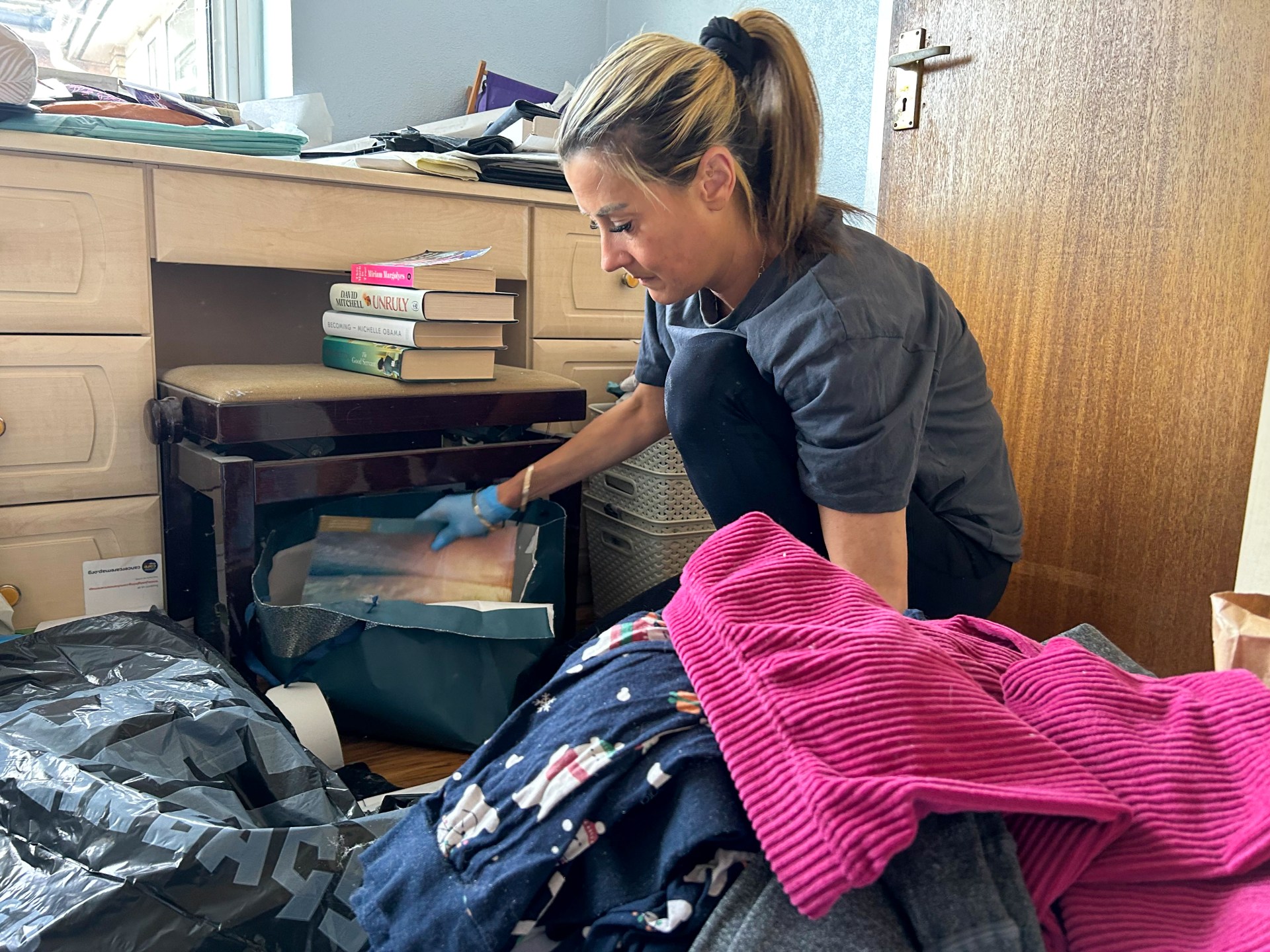
London and Whitstable, United Kingdom – It’s an unusually warm day in mid-November, and 43-year-old Jo Powell is rolling up her sleeves as she enters a bedroom filled with piles of clothing and bags stuffed to the brim with documents and other paraphernalia.
It’s hard to walk around without tripping, so Jo is treading carefully. Two small dressers on either side of the bed are submerged under books and tissue paper. Only the mattress, adorned by a colourful crocheted throw, isn’t buried under other objects.
Jo, the director of Hoarder Clean Up UK, is spending the morning in this semidetached home in a southeast London suburb. Her client, Emily, a pseudonym, is a woman in her mid-30s who asked that her identity be withheld for privacy reasons.
Emily has booked Jo for half a day to start clearing her elderly mother’s room so that a new bed can be delivered. When Jo arrived, she briefly met the mother downstairs, and the petite, frail-looking woman seemed wary of the cleanup plan despite having ordered the bed herself. Emily gently reminded her mother why Jo was there, and the older woman reluctantly agreed before retreating to the living room.
Jo sets down her bin bags, rubber gloves, cleaning spray, a brush and a duster on top of a desk by the door. Her arms akimbo, she begins surveying the cluttered space.
“This is what it’s like,” says Emily, her hands motioning towards the piles, her face flushed as she follows Jo’s gaze across the room. “There’s also mould on the windows, and the toilet needs dealing with. I know it’s probably not the worst case you’ve seen, but I just want her to be comfortable.”
“No problem,” Jo says, smiling as she reaches for an empty box she’s spotted under the desk. She asks Emily if she can help decide what should be kept, and the latter agrees. “We’ll work quickly but also be careful,” Jo tells her.
![Jo Powell dons gloves as she sifts through a hoarder's belongings, carefully picking out important mementoes. [Amandas Ong/Al Jazeera]](https://www.aljazeera.com/wp-content/uploads/2025/11/Midway-through-a-hoarder-cleaning-job-1763557990.jpg?w=770&resize=770%2C578&quality=80)
Travel trinkets and old receipts
Jo is dressed in a grey T-shirt and black leggings, and has her dyed blonde hair pulled back in a neat ponytail. Outside of work, she swears and cracks jokes often, but on this job, sensing the tension in the home, she is attentive but not overly serious, with the air of someone accustomed to being invited into people’s lives in vulnerable moments.
Her voice is reassuring but decisive when she speaks to Emily, taking charge of the situation by suggesting which areas of the room to prioritise for the cleaning, and moving in a light-footed fashion from one spot in the crammed room to another, without knocking anything over. There’s a deftness and agility in her hands as she picks out small, otherwise inconspicuous souvenirs from the first box she reaches for.
She suggests sorting objects into different piles: paper recycling, plastic recycling, donations, items to keep, and, one for things that need to be thrown out. She works methodically, checking whenever something looks like it might matter, whether it’s dusty bank letters, insurance policies or a good luck charm from a temple in Japan. For outdated documents containing biographical details, she suggests Emily shred them.
The two women settle into an easy rhythm, chatting as they work. Jo’s tone is warm as she helps Emily decide what stays and what goes.
Emily mentions her middle-aged brother, who is autistic and lives in the house. He reacts adversely to changes in his environment, and Emily is worried about how he will respond today.
“The last time I tried to clear the room,” she recalls, “he nearly broke the door down. I almost called the police.”
Then she exhales sharply, making an unexpected admission: her mother was diagnosed with late-stage cancer just two weeks ago.
“She’s had a very full life, but she’s still finding it hard to take in,” Emily says quietly. “The prognosis is three to six months.”
“I’m so sorry,” Jo says, straightening up. For a few moments, her busy hands are still. “That must be so hard. For her, but also for you.”
Gradually, as they work, the room begins to reveal the mother’s past as a civil servant with a penchant for travel.
The “keep” pile, the artefacts of her life, fills two green boxes. It includes thick files with notes from a linguistics course, sheets of Vietnamese greetings from a cruise holiday, a programme from a passion play staged in a German town once every decade, trinkets from Patagonia, holographic postcards of Huskies from the Arctic Circle, yellowing cards written to her late husband before marriage, funeral invitations and travel guidebooks.
Jo is nimble and decisive. The dedicated piles grow. They consist of stacks of supermarket brochures, old skincare products and receipts for food for a long-deceased cat. Filled bags are brought downstairs to the recycling bin or placed into the boot of Jo’s car. Emily seems to relax as the room sheds its weight.
Suddenly, Emily’s mother appears. She’s in the doorway, gripping the frame. Her eyes dart around the partly cleared room.
“I was so afraid that this is what I’d find!” she says, her voice breaking and her hands trembling. “There’s so much history here, no one else understands. I’m going to come back later, and I won’t even recognise my own home!”
![Jo Powell carefully goes through items in a hoarder's bedroom, ensuring that nothing important gets thrown away. [Amandas Ong/Al Jazeera]](https://www.aljazeera.com/wp-content/uploads/2025/11/Jo-Powell-carefully-going-through-items-in-a-bedroom-thats-been-hoarded-to-ensure-that-nothing-important-is-mistakenly-discarded-1763557965.jpg?w=770&resize=770%2C578&quality=80)
Going it alone
Since early 2022, Jo has been working around London and southeast England, helping people with hoarding behaviours to clear, pack and sort their homes.
Wobbling, ceiling-high pillars of empty boxes, rotting food, broken furniture, stashed faecal matter, and doorways obstructed by piles are all part of a day’s work.
Before setting up her own company, Jo worked in sales for another firm that provided an array of services, including hoarder cleaning and specialised cleanups after people have died on their own or in a traumatic way, often as victims of a violent crime. Her role involved answering the phone and speaking to customers, and quite soon into her job, she was struck by how emotional the calls were.
“It really affected me, having people crying down the phone,” she recalls. “[People who hoard] are so ashamed. It’s [often] a mental health issue at the end of the day.”
A turning point came in 2021, when a young woman called about trauma cleaning after her father’s suicide. Jo, whose stepbrother had taken his own life 12 years earlier, stayed on the line with the woman, offering support long after the work call would normally have ended.
It struck her that she might be someone who could show up differently for clients in crisis. Then came the case that sealed her decision: The company had a client whose toilet had for years been filled to the brim with paper and faeces, so she resorted to containers and bags that she couldn’t face dealing with.
“Bear in mind, people are mortified letting strangers see this,” Jo says. “No one’s been inside their homes in 10, 20, sometimes 40 years.”
The woman tearfully rang her during the clearing process, humiliated that a neighbour had complained and asked if the skip that had been placed in the communal parking area for the job could be removed.
By then, Jo realised that she’d listened to too many firsthand accounts of hoarding clients being shamed or berated, instead of being treated with sensitivity.
“That was when I was like, ‘Wow, I need to go and do something on my own,’” she says.
![An example of hoarding seen halfway through a cleanup. [Amandas Ong/Al Jazeera]](https://www.aljazeera.com/wp-content/uploads/2025/11/Midway-through-the-cleanup-1763557953.jpg?w=770&resize=770%2C578&quality=80)
Cleaning to cope with grief
Despite a lack of professional cleaning experience and staff, Jo set up shop, gaining knowledge on the job. She believes that her difficult personal experiences have helped her navigate the fear and sorrow she encounters in her clients.
“I lost my parents when I was quite young,” she explains. “I was 20 when my dad died, and [I] was in a very, very bad way. My mum was also already ill at the time, but we didn’t know that.”
When her mother passed away two years later, Jo moved in with a friend, and she found herself regularly staying up until three in the morning, cleaning to cope with her grief.
At the time, Jo was also on antidepressants and working at a clothing retailer.
“I was like a zombie,” she recalls. “But nobody would’ve known, because I was the life and soul of the place. Then, as soon as I walked out to the car, I’d think, ‘You don’t need to put on this façade any more.’”
More than two decades on, Jo’s mental health still fluctuates, but she believes this allows her to relate to the people she helps and understand what it’s like to hide one’s pain.
Many of her hoarding clients might appear put-together in public but have homes crammed with objects they can scarcely wade through. Among her clients are bankers, surgeons, high-ranking civil servants and a judge. The shame they carry cuts across different walks of life, she observes, regardless of how they appear in public.
“People think that hoarding is just about clutter,” she adds. “It’s not.”
When people struggle to let go of possessions, she explains, “It’s about fear, and often about trauma.”
She’s observed that bereavement is a common factor among her clients: after losing loved ones, some react by accumulating more possessions that otherwise appear of no value to others. In some cases, she’s visited homes where younger members of the family hoard because they have older relatives who do.
“Because [a hoarding disorder] is about mental health, literally anyone can be affected by it,” she emphasises. “A lot of the time, buying and keeping things is about control, so you have all these things around you that you don’t even open, but you look forward to.”
![While cleaning through a hoarder's bedroom, Jo Powell finds a menu written by the client's daughter for Mothers' Day, a sweet reminder of her childhood. [Amandas Ong/Al Jazeera]](https://www.aljazeera.com/wp-content/uploads/2025/11/A-menu-for-Mothers-Day-written-by-the-client-to-her-mother-when-she-was-a-child-1763557939.jpg?w=770&resize=770%2C577&quality=80)
‘Caught in the crossfire’
Back in the bedroom in southeast London, the atmosphere is growing tense. As Emily’s mother recoils at the sight of her partially cleared room, her brother is stamping upstairs, holding travel brochures he has retrieved from the recycling bin.
“You’ve thrown these away,” he accuses his sister. She snaps back instantly, anger contorting her face: “You’re not helping at all!” He backs away.
Jo steps in. She doesn’t flinch or rush towards Emily’s mother, but defuses the situation by picking up one of the green boxes and showing it to her.
“We’re really being very careful,” Jo tells her gently. “We’re keeping everything important to you. Please don’t worry.”
At this, the elderly woman’s shoulders soften, and she sinks onto the edge of her bed.
Emily’s lower lip quivers as tears form.
“I’m sorry for raising my voice,” she says to Jo. “You must think I’m so hard-hearted.”
Jo shakes her head firmly and gives her shoulder a squeeze.
Emily gathers herself, then guides her mother downstairs. When she returns minutes later, she’s more composed. Jo pauses the sorting.
“Are you all right?” she asks her with concern. Emily nods, holding back emotion.
Jo tells her that moments like these are common under stress and that she shouldn’t feel bad.
“You’re doing a lot on your own,” Jo says, and asks if she has anyone supporting her through this.
“Not really,” Emily admits. “Just my husband, who’s been great.” Jo nods before they resume sorting.
A folded card made of thick cream paper emerges from one of the boxes. Emily opens it and lets out a short, surprised laugh.
“Oh, this must’ve been me, before I could spell,” she says.
She is holding a Mother’s Day menu written in colourful ink: a sliced pear in exchange for two kisses, a “main coarse” of scrambled eggs and cereal for different numbers of hugs. Her expression is half-amused, half-sad as she murmurs: “It’s funny. I wasn’t that close to her growing up, only later.”
As the appointment winds down, Jo sets aside a cluster of objects on the desk, mostly souvenirs from Emily’s mother’s travels that she thinks will bring her solace.
“We shouldn’t do any more today,” Jo advises. “It’d be too much for her.”
Jo will return the following week to continue the clearing.
Hours later, Jo’s phone buzzes. It’s a message from Emily. Her mother is pleased with how the room looks, and with time, Emily hopes she’ll come to appreciate the change even more.
Jo admits that it’s one of the more complicated jobs she’s encountered.
“A lot of the time, it’s about persuading people to part with heaps of empty boxes, milk cartons, stuff that’s rotted all the way through. Most of what’s hoarded can’t be saved,” she reflects. “But in that room, there were so many things that genuinely meant something to her. We can’t throw them away, especially since she’s close to the end of her life.”
The presence of family members with conflicting views made the job harder, she adds.
“You really do get caught in the crossfire.”

‘I just can’t sit down’
A week before the cleanup, Jo was at home in Whitstable, on the north coast of Kent, where she lives with her three young sons and partner.
In the small room she uses as her office, shelves and drawer-tops are crowded with tongue-in-cheek signs printed with swear words and figurines of raised middle fingers, trinkets that make her smile. Some are gifts from friends and relatives, while others she purchased herself. Framed family pictures line the walls of her home, and by her desk is a photo of Bailey, her pet Doberman, whom she credits with keeping her alive when she was depressed after her parents’ deaths.
“If it wasn’t for her, I wouldn’t be here, a million percent,” she says about her now-deceased pet.
Even though she’s at home, her eyes flit everywhere, always looking for something to clean. Keeping still and not being busy with her hands, she says, means having to “think about [herself]”, which she declares with a shudder, is the “worst thing”.
She admits that she struggles to relax. When her partner suggests they watch a film together, she often finds it too difficult to sit still.
“I just can’t sit down,” she says with a slightly regretful laugh. “I need to hoover. I need to clean the windows, look after the plants.
“It’s exasperating for him when I get up and start doing stuff,” she adds.
She even keeps her hands busy when she’s on call for work, doodling or crafting little objects out of whatever scrap material is nearby.
Calls and messages from potential clients come in every 15 minutes, several asking if she and her team — Jo now has five employees — can remove mould in their homes, which is the bulk of their cleaning work. When her rap music ringtone sounds, she answers the phone in a friendly manner, patiently addressing each query and asking for photos before sending quotes.
Typically, the fee for half a day’s work involving two cleaners comes to 600 pounds ($800), with a full day costing 1,200 pounds ($1,600).
Though she tries to keep fees affordable by industry standards, she’s aware that the cost might still be too high for some. She hopes to secure charitable funding in the future, so everyone who needs help can get it. For a change of scene in her work day, she carries her laptop into the light-filled extension to her living room overlooking a sloping garden with two chicken coops in the corner. Her 14-year-old dog, Harvey, snoozes at her feet.

‘Making them feel human’
One of her colleagues calls about a hoarding client they’ve helped recently — a woman who lived with rubbish all around her home and cat faeces scattered across the floor.
Jo insists that her staff keep bagged waste discreetly inside the properties or gardens until there’s enough to fill a dump truck. The aim is to spare people the embarrassment of having neighbours witness a skip being filled over several days. She also tries to work only with waste-removal firms that are respectful to her clients.
This time, however, something’s gone wrong. The contracted removal team was rude to the woman and invoiced her directly instead of billing Jo’s company, as they should have. Upset, the woman forwarded the invoice to Jo’s colleague, explaining how distressed she was.
“I’m not having that,” Jo says sternly. “I don’t want to use this company any more if they’re going to be judging people like this.”
When she ends the call, she’s glum.
“I already know we’ve lost her confidence. We probably needed more visits to her property to really clean it out, but that chance is gone now,” she sighs.
“It’s so sensitive, and her emotions are so heightened. I’m putting myself in her shoes – she probably wouldn’t want us to come back. Even though we’ve done nothing wrong.”
Jo learned quickly when she started hoarder cleaning to adapt to her customers’ needs.
“Everyone is different, and it’s important to respect that,” she says. “Some people don’t want sympathy; they just want to crack on with it. Others want to talk, and you leave knowing their life stories. It’s not just manpower. It’s moral support.”
Her job, she believes, is to take “baby steps” towards helping people “feel dignified and making them feel human again”, rather than “ransacking the place like a bull in a china shop”.
“It sounds corny,” she says enthusiastically, “but I just love being able to help others. I genuinely do want to make a difference.”
When recalling past cases, she grows animated, as if she’s right there at the scene again.
One early client lived just a stone’s throw from the department store Harrods, in one of the most expensive parts of London.
“You know what it’s like when you can’t find something, and you think, I’ll just buy another one? Well, she was like that with umbrellas,” Jo says, chuckling at the memory.
“I think we counted 24 of them.”
Jo and her colleague built a good rapport with the woman over several days of clearing, with the three having lunch together.
She convinced the woman to donate many of her unneeded belongings to charity. Eventually, they cleared her bed so she could sleep in it for the first time in years, instead of on a chair. The woman was so grateful to Jo that she asked her to go duvet shopping with her to celebrate.
Another time, Jo helped a client who had lived with her mother until the parent died. She sensed the woman was still grieving, and her mother’s room was almost completely hoarded to the door.
While cleaning, Jo found a gift bag with a pebble inside. Instead of throwing it away, she asked if it might be sentimental. The client became emotional, explaining that the pebble was tied to a happy memory with her late mother. “It’s why we have to take care while cleaning, even if there’s a lot of stuff to get through,” Jo says. “Even really small objects that you might miss might really matter to somebody.”
Some jobs, meanwhile, have been disconcerting.
Jo was once clearing out piles of paper and books from a client’s study when her assistant entered, whispering in alarm that he was sitting outside, stroking his collection of long knives.
As she cleaned, “he followed me around quite a bit,” Jo remembers. “That was really uncomfortable.”
Her assistant, who had a black belt in jiujitsu, made sure Jo was never left alone in a room with the man.
And yet, despite concern for her safety, Jo felt sympathy for the man. Through snippets of conversation, she learned that he had a wife and two adult sons who no longer had anything to do with him.
“In one of the bedrooms, there were still board games and toys from the time the boys were small, and none of it was salvageable,” she remembers, her tone sombre.
The need to hoard
Something Jo often tells the people she helps to put them at ease is that everybody — including her — “feels the need to hoard in some way”.
She goes to retrieve a large box from her garage, and brings it to her office. Inside, wrapped in layers of paper and bubble wrap, is a heavy black metal bull figurine.
“Oh no!” she exclaims in dismay as she gingerly removes it. “Look, its horn has fallen off!”
Her mother had loved bulls and collected dozens of them. Some sit on shelves around Jo’s home today, but the rest are in storage.
“My mum’s gone nearly 21 years now, but I can’t bear to sell them or get rid of them,” she explains. “What’s the point of my keeping them? Bulls are not even my thing,” she adds, but the objects are a link to her mother.
“This is what I tell my clients: Something could seem like a waste to everyone else, but we still want to hold on to it.”
She takes out a plastic container full of her mother’s belongings that she hasn’t touched in decades.
“I don’t even know what some of these are,” she confesses, rifling through envelopes stuffed with documents. “Probably from her time in America when she was working there.”
She gets visibly excited when she finds a book of children’s poetry, its browning pages coming apart at the bind.
“Oh my God, I remember this! My mum used to read it to me,” she says.
As she tenderly puts everything back into the box, she adds ruefully, “And now it’s probably going to go back into storage, and I’ll never look at it again.”
Jo heads outside, where her chickens peck at the grass near the small patch of earth where her favourite cockerel, Shim, was buried four months ago. The colourful splint she once made for him when he had a bad leg – with its three bright toes jutting upward – lies on top of his burial spot.
“It actually worked really well,” she says. “But he just suddenly died.”
Jo pauses, watching the other chickens move across the grass. “Chickens are very good at hiding what’s really wrong with them,” she says.
As she returns to the house, she muses about another query for hoarder cleaning she’s just received. Each time she sees a new message, she’s reminded that every potential client represents someone who summoned up the courage to reach out after years, possibly decades, of managing alone.
“You come across so much in this job, there’s really nothing I haven’t seen,” she says. “People need to know that they can get help without being judged. So it’s really important to tailor how you act with each individual and get to know them as much as you can.”
What she carries forward from her own experience of grief and late-night cleaning is an understanding of what it means to push through life’s struggles: not perfectly, but with determination and not alone.
“That’s what I’m trying to do with my work,” she says. “Just to be there for my clients, and support them through something difficult, with a laugh if that’s possible.”
