


CORTINA D’AMPEZZO, Italy (AP) — A giant portrait of Benito Mussolini hovered over the “Snow Stadium” — on the exact same grounds where the curling arena for the Milan Cortina Winter Olympics now stands.
The shooting range for the military patrol event — the precursor to biathlon — was held where a mobile-home Athletes’ Village has now been erected to host competitors for next month’s Games.
Olympic fans may know that Cortina d’Ampezzo hosted the Winter Games once before, in 1956. Less well known is that 15 years earlier, during World War II, the Italian town held a world skiing championships that served as a propaganda showcase for fascist Italy and Nazi Germany.
Germany — competing under the swastika flag and able to rely on expert skiers from annexed Austria — and Mussolini-controlled Italy swept the Alpine medals with the Axis powers’ enemies excluded.
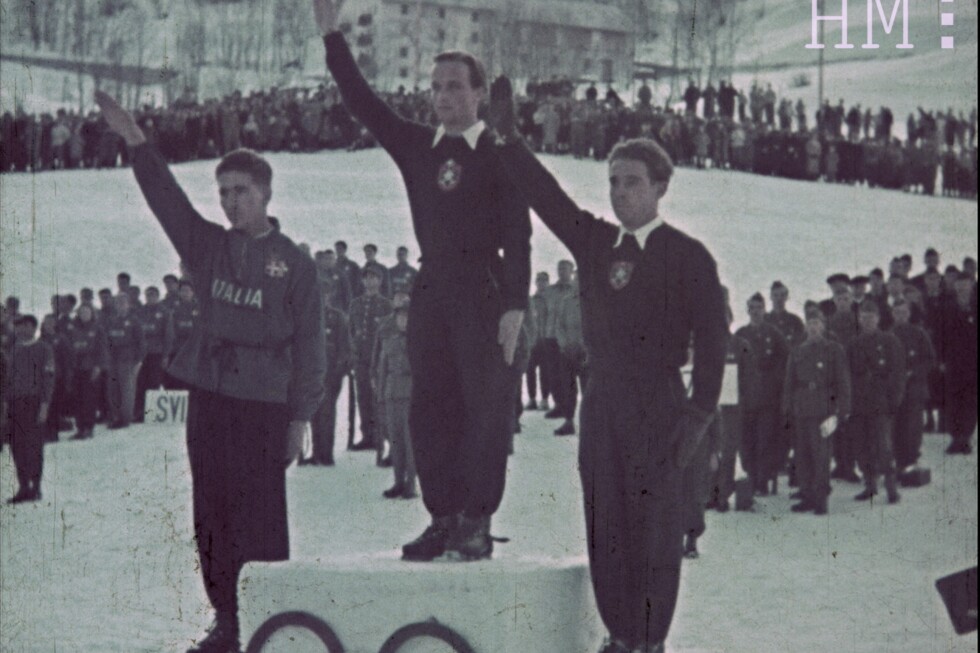
Old newsreels from the 1941 championships and an amateur film show athletes giving fascist salutes on medal stands, Nazi flags displayed throughout Cortina and a heavy military presence.
After the war, the International Skiing Federation (FIS) wiped out all the results — which is one of the main reasons that the event remains mostly unknown.
“In many ways it’s like it never happened,” said Nicola Sbetti, a sports historian at the University of Bologna. “And the Italian republic has never been interested in taking responsibility for the championships.”
He said the event was part of an Axis plan “to create a new world order,” also in sports.
“Germany — and also Italy and Japan — wanted sports events to continue being held as if nothing else was going on. And so this was one of the last big international events held (before the war expanded),” Sbetti said.
But it wasn’t truly an international event, because Allied nations like Britain, France and the United States were excluded, occupied Norway was represented by a weakened team and neutral Switzerland wasn’t at full strength either.
“It was a world championships where you had the Axis countries, neutral countries, and puppet states like Slovakia,” Sbetti said. “Norway under (Nazi collaborator Vidkun) Quisling participated only with athletes who fell into line. Yugoslavia participated and then was invaded two months later.”
Italy treated the event like a ‘mini-Olympics’
Before the war, Cortina had been assigned hosting rights for the 1944 Winter Olympics — which were then canceled as the war progressed.
But Mussolini, Italy’s fascist leader, wouldn’t be deterred.
The 1941 worlds weren’t just for Alpine skiing. The competition also included Nordic events like cross-country skiing, Nordic combined and ski jumping.
“Mussolini said to his men, ‘I’ll do it anyhow,’” said Max Vergani, the communications director for the Italian Winter Sports Federation, who wrote a book titled “Cortina41, Il Mondiale fantasma” — which translates to “The phantom world championship.”
“They couldn’t host the Olympics, but they did host the world championships,” Vergani said. “It was essentially a mini-Olympics.”
On a smaller scale, the worlds were a demonstration of force and power akin to when Adolf Hitler’s Germany hosted the 1936 Summer and Winter Olympics in Berlin and Garmisch-Partenkirchen, respectively.
“It was a world championship heavily (influenced) by the regime, to show that Italians are strong, that Italy is a strong country, that the war doesn’t touch me and I am able to produce a great sports show because I am calm, I will win the war,” Vergani said.
The championships took place while the Axis powers held sway across much of Europe. Nazi Germany was escalating its persecution of Jews and planning for Operation Barbarossa, the ill-fated invasion of the Soviet Union which would be launched just months later. Meanwhile, Italian forces were struggling against the British in North Africa, prompting the arrival of German reinforcements.
Medalists made Nazi salutes on the podium
The outstanding skier of the 1941 worlds was Christl Cranz, the German who swept golds in downhill and combined and took silver in slalom.
When Cranz led teammates Käthe Grasegger and Anneliese Schuh in a German podium sweep in downhill, all three women performed Nazi salutes on the medal stand while wearing shirts emblazoned with a swastika emblem.
With her three podium finishes from 1941 stripped, Cranz’s record total of 15 career medals at worlds was matched by Mikaela Shiffrin last year when the American teamed with Breezy Johnson to win the new team combined event at the 2025 world championships in Austria.
On the men’s side, Austrian-born Josef Jennewein also swept gold in downhill and combined for Germany.
The only non-German winner in Alpine skiing was 20-year-old Celina Seghi, an Italian who produced an upset victory over Cranz in the slalom.
Of the 18 Alpine medals, Germany claimed 11 and Italy took the other seven.
It was, Vergani said, “as if Mussolini wrote the medal table himself.”
The medal table for the Nordic events wasn’t very extensive either. Finland, which was then being aided by Germany in its fight against the Soviet Union, led with seven medals, followed by Sweden (5), Germany (2) and Italy (1).
Gustav Berauer and Josef Gstrein took gold and bronze for Germany in Nordic combined even though they were from Czechoslovakia and Austria, respectively. Both of their countries were occupied by the Nazis.
Sweden won the 25-kilometer military patrol competition ahead of Germany and Italy.
Norway, historically a leader in Nordic events, didn’t win a single medal.
Several medalists died in the war
While the 1941 championship was wiped out after the war, a hand-written version of the official results recently came to light.
Vergani found the results in a “very old, very dusty binder” in the Italian federation’s archives. His book, though, was a private initiative.
Many of the athletes who competed in 1941 did not survive the war.
Jennewein became a skilled fighter pilot for the Luftwaffe. His plane was shot down over the Soviet Union in 1943.
Rudolf Cranz, Christl’s younger brother and the 1941 bronze medalist in downhill, was killed on the Eastern front later that year, as was ski jumping gold medalist Paavo Vierto of Finland.
Berauer was seriously wounded on the Eastern front and never competed again. From 1963 to 1975 he served as chairman of the FIS’ Nordic combined committee.
Seghi continued competing after the war. She finished fourth in downhill and combined at the 1948 Olympics in St. Moritz and then earned bronze in slalom at the 1950 worlds in Aspen, Colorado, for her only recognized medal, then retired shortly before the 1956 Winter Games. She died at 102 in 2022.
At the first FIS congress after WWII, held in August, 1946 in Pau, France, the cancellation of the 1941 worlds was the first item on the agenda.
The motion, which was proposed by the U.S., Belgium and Austria, passed immediately and all of the medals were ordered withdrawn.
Eventually, the event was overshadowed by the 1956 Winter Olympics in Cortina, which became a symbol of revival as Italy embraced democratic values after the war.
Today, there are few physical traces of the 1941 championships, though souvenir shops in Cortina still sell items with the image of the worlds’ official poster on them.
“History is history,” Sbetti said. “So even if the event was canceled, it still happened. It needs to be remembered. But in this case the political elements need to be contextualized.”
___
AP Olympics: https://apnews.com/hub/milan-cortina-2026-winter-olympics
