


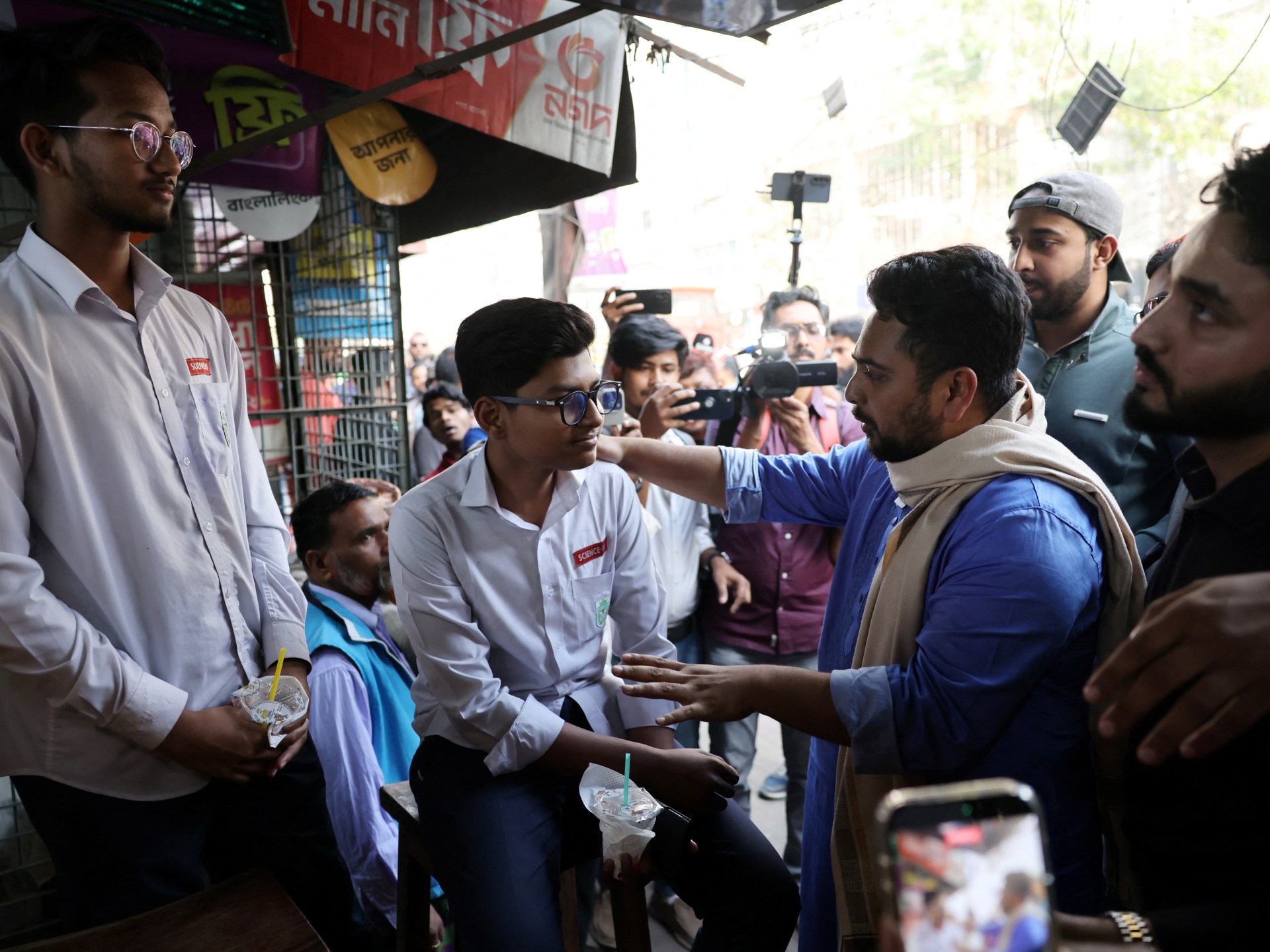
Mohaiminul Rafi, 27, has spent years preparing for Bangladesh’s civil service exams, chasing what he calls “the most reliable route to a secure life”: a first-class government job.
With election campaigning under way across the country, he is now hearing promises aimed squarely at people like him: cash support or interest-free loans for the jobless, and sweeping job-creation targets.
When asked about cash support or interest-free loans for unemployed graduates, Rafi chuckled. “Of course it would help,” he said. Then he paused. “But honestly, what matters more is a healthy job market and recruitment on merit.”
Rafi was among the wave of young people who joined the 2024 protests that began over a job reservation system many saw as unfair and later spiralled into a nationwide uprising that toppled then-Prime Minister Sheikh Hasina’s government.
Now, Bangladesh is heading to an election on February 12.
With Hasina’s Awami League barred from the ballot, the race is expected to largely revolve around a Bangladesh Nationalist Party (BNP)-led coalition and a bloc led by the Jamaat-e-Islami, which has courted liberal allies, including the uprising-born National Citizen Party.
Senior figures from both camps are crisscrossing the country, headlining rallies and stage programmes as campaigning enters its final stretch. From platforms to doorsteps to social media, candidates and party activists are tapping familiar anxieties: jobs, price relief, tax cuts, and an end to corruption and discrimination.
But analysts and voters say that while many of the promises go to the heart of people’s insecurities, the scale of what is being offered might be difficult for any government to realistically deliver at a time when Bangladesh is grappling with multiple economic challenges.
“Everyone is promising jobs and social security like it’s a switch they can turn on overnight,” Rafi said.
The promises land in an economy in which growth has slowed to about 4-5 percent in recent years – after expanding above 8 percent before the pandemic in 2019 – while food and overall inflation have remained in the high single digits for a prolonged period, squeezing people’s purchasing power and driving up the cost of living.
Private investment has remained largely stuck at roughly 22–23 percent of gross domestic product (GDP), and the nation’s tax-to-GDP ratio is still under 7 percent. This is compared with roughly 12 percent in India and 10 percent in Pakistan, and is far short of the roughly 15 percent many economists cite as a minimum for a state to sustainably fund basic services without chronic fiscal stress.
Hossain Zillur Rahman, an economist and the executive chairman of the Power and Participation Research Centre (PPRC), a nonprofit think tank based in Dhaka, said the interim administration led by Nobel laureate Muhammad Yunus that took over after Hasina’s ouster brought “some measure of immediate stability to macro indicators”.
But the Yunus administration, he added, has been “extraordinarily inattentive to economic distress at [the] household level” and to “engaging with the business community to jumpstart the economy”.
“The economic reality at this moment is marked by persistent inflation, poverty reversals, employment emergencies, stagnant wages,” he said, adding that the government has “failed to generate business confidence, which is why the investment rate is at a standstill”.
Against that backdrop, he added, an election matters because it may end the uncertainty freezing decisions. “Bangladesh urgently needs a restart,” Rahman said. “[The] election opens the possibility of that, but it is unlikely to produce any dramatic improvements.”

Competing promises
Amid this tense economic mood, both the BNP and Jamaat-e-Islami, also known as Jamaat, are selling a broad menu of pledges. The parties are yet to release manifestos, but officials from both camps told Al Jazeera that policies unveiled at separate recent high-profile events in Dhaka, and now circulating throughout the campaign, will feature prominently.
The BNP’s flagship pledge is a “family card” issued in the name of a woman in each household. The party says it would initially cover 4 million households, providing either 2,000 to 2,500 Bangladeshi taka (about $16–$20) a month in cash, usable at designated stores, or an equivalent monthly basket of essentials such as rice, pulses, oil and salt.
Amir Khasru Mahmud Chowdhury, a BNP leader and former minister of commerce, said that if elected, the BNP plans to govern by investing in people, “in health, in education, and upskilling”, and by supporting “artisans, the weavers” and small industries with credit, as well as helping them access international markets, including by helping them with their branding.
Economists say the challenge lies in scale and delivery. Bangladesh currently spends about 1.16 trillion taka a year (roughly $9.5bn) – about 2 percent of GDP – on social protection across more than 130 programmes, such as old-age allowances and widow benefits.
The BNP’s family card pledge, if fulfilled nationwide, would cost roughly 1.2 trillion taka (about $9.8bn) a year, assuming 2,500 taka ($20) per card. Bangladesh’s current outlay on social sector protections would effectively need to double to make this work.
“You cannot ensure quality social security with just 2 percent of GDP,” Towfiqul Islam Khan, additional director (research) at the Centre for Policy Dialogue (CPD), said.
For Rahman of the PPRC, social protection pledges amount to an “acid test” for the parties. “The key challenge here is not just extra budget”, he said, “but avoiding leakage and ensuring delivery to the right target groups”.
The BNP argues its answer lies in shrinking the bureaucracy and digitising services. Khasru described Bangladesh as “an over-regulated country” where layers of permissions raise the “cost of doing business”. Moving services online and eliminating physical contact with officials, he said, would reduce opportunities for corruption.
Meanwhile, Jamaat’s principal welfare pitch is a “smart social security card”, a unified system the party says would connect the National ID card, health access, taxation, and social safety services.
Mokarram Hossain, a Swansea University professor who helped coordinate Jamaat’s plan, said the party’s focus rests on “good governance, zero tolerance to corruption, zero tolerance to extortion, and efficiency gains”.
Hossain said Jamaat’s plan is not to “hand out token cash”, but to build a single system through which people can access services, something he argued would also reduce “leakage” in how benefits are delivered.
Khan of the CPD said that “if revenue collection improves, these long-term plans [of both coalitions] can be implemented… and they should be”.
But for the moment, he said, both the BNP and Jamaat have questions to answer.
“They need to clearly explain how the financing will be arranged, how long implementation will take, through what process it will be done, and how institutional capacity will be strengthened [to enable the execution of these policies],” Khan said.
Still, there is a reason why these promises, irrespective of how realistic they are, resonate with many voters, said Asif Shahan, a Dhaka University professor and senior research fellow at the BRAC Institute of Governance and Development, a social science research and academic institute in Dhaka.
“People don’t like complicated messages,” he said. “You have to give people a very simplified message.” This is why the idea of a “family card” and a “social security card” works better than detailed policy blueprints, he said.
But it is not that the everyday voter is not discerning, he said. Voters are watching to see whether a party will deliver benefits fairly to everyone, or “only give them to party loyalists”, he said.

Jobs, education and youth
Card-based welfare promises are only one side of the campaign pitch.
Both blocs are courting young voters, roughly one-third of Bangladesh’s 127 million electorate, with sweeping job pledges.
Government data shows unemployment among college-educated people is at 13.5 percent as of 2024, leaving about 885,000 graduates without work, while overall unemployment stands at 4.63 percent, with roughly 2.7 million people.
The BNP has pledged to create 10 million jobs within 18 months and provide financial support to the “educated unemployed” until they find work, as well as ensure “merit-based government recruitment”.
It has also pitched the “digital economy as a major employer”, promising 800,000 information technology jobs and the introduction of international payment gateways, such as PayPal, to ease cross-border earnings for freelancers.
Chowdhury, the senior BNP leader, said Bangladesh’s homegrown payment systems are “very poor”, and that multiple gateways would “create competition and support online workers, as well as make cross-border business easier”.
Jamaat’s jobs pitch, meanwhile, leans heavily on training and placement. It has pledged to train 10 million youth within five years, saying it would establish a “youth tech lab” in every sub-district and set up district-level “job banks” to connect people to 5 million jobs within the same period.
It also promises to create 500,000 entrepreneurs, develop 1.5 million freelancers, and design “separate skills programmes for young people with lower formal education”.
But Jamaat has also offered unemployed graduates interest-free monthly loans of up to 10,000 taka (about $80) for up to two years.
Hossain, the Swansea University professor, stressed that the support would need to be repaid. “We are not ‘giving’ the money,” he said. “We are giving a loan, but interest-free.”
But economists say delivering the job creation both sides are promising would require sustained GDP growth of 8 to 10 percent and a considerable surge in domestic and foreign investment.
The PPRC’s Rahman said he was sceptical about interest-free loans as a fix. “Interest-free loans tend to be populist measures without much proven impact,” he said, arguing that “the solutions for unemployed graduates are their skilling and actual employment opportunities”.
Education has also become central to campaign promises.
BNP’s education proposals include a “one teacher, one tab” initiative, under which the party says it would provide tablet computers to primary and secondary teachers to support teaching and training. It also plans to expand multimedia classrooms, introduce compulsory vocational education at the secondary level, and strengthen technical and skills-based training alongside general education.
The party has further pledged to expand midday meals for students. Bangladesh currently runs a school feeding programme in parts of the primary and elementary school system, but coverage remains limited and uneven, and there is no nationwide scheme at the secondary level.
The BNP has also said it would expand sport, arts and cultural education, as well as introduce third-language learning – including Arabic, Chinese, Korean, Japanese and German, alongside Bengali and English – from the secondary stage, which party leaders argue would improve employability at home and abroad.
BNP leader Chowdhury said Bangladesh’s education system pushes too many students towards advanced degrees, which “creates more jobless people”, and that the BNP wants vocational schools “all around the country”, so more students move into skills tracks after high school. He pointed to China, where he said that “60 percent go to vocational education”, which helps young people find work “at home… [and] abroad”.
Jamaat’s education platform includes interest-free education loans of up to 10,000 taka (about $80) per month for 100,000 students selected on merit and need, annual support for 100 students a year to study at top global universities, and upgrading large colleges into full universities.
Hossain said Jamaat’s overseas-study pledge is limited. Students admitted to “fixed top universities… MIT, Harvard, Oxford, Cambridge” would “get all the money”, while others would receive support for “the first two semesters” and repay the rest as an interest-free loan.
Rahman urged caution over student loan-style pledges. “The idea of student loans also needs to be thought through with care,” he said. “The burden of student loans hangs like a baleful cloud over the large swath of youth in the developed world.”
He argued that expanded scholarship schemes with strict targeting and compliance conditions could be a safer approach.

Tax cuts and the revenue squeeze
While the BNP has not specified tax rates and has instead promised more generic “business-friendly reforms and deregulation”, Jamaat has been explicit on taxes, proposing cuts that would bring “corporate tax down to 19 percent and VAT [value-added tax] to 10 percent”.
At present, economists say, some companies face tax rates exceeding 50 percent, while taxes on discouraged and luxury goods can reach 700 to 800 percent.
Hossain of Swansea University said Jamaat’s finance policy team estimates that just by tightening tax collection, “plugging loopholes and curbing corruption in tax administration”, it could recover 1.05 to 2 trillion taka (roughly $8.5bn to $16.4bn), which would help fund the “party’s promises without expanding the budget”.
He said that the same team has put the estimated cost of implementing Jamaat’s proposals at 2.37 trillion taka (about $19bn), while it projects “potential revenue sources” of 2.21 trillion to 3.16 trillion taka (roughly $18bn to $25.7bn), driven largely by “tighter taxation” alongside “efficiency gains” and “debt restructuring”.
But the CPD’s Khan said Bangladesh needed a broader overhaul of the revenue system, which would also help boost investment. “A service-oriented tax system, automated return filing and assessment, and efficient tax refunds are essential,” he said. “This would reduce tax evasion and administrative delays, and increase revenue.”
Industry costs, farmers and health
Jamaat has pledged to freeze industrial utility – gas, electricity and water – tariffs for three years to help businesses. It has also proposed reopening closed factories through public-private partnerships, with 10 percent ownership allocated to workers.
Rahman, the economist, said that “among the promises made by Jamaat, the one which has most merit is to freeze utility tariffs for the industrial sector for three years”.
The BNP’s pitch to business is less about a single pledge and more about a structural reset.
Chowdhury framed it as moving away from an “oligarchic economy” tied to businesses with political power and towards what he called a “democratisation of the economy”, with a level playing field for all firms.
In agriculture, the BNP has proposed a “farmer card” offering “subsidised fertiliser, seeds and pesticides, access to machinery, easier loans, crop insurance, fair-price sales and mobile access to market and weather information”.
Jamaat has promised interest-free loans for small and medium farmers.
But agriculture policy is already tied to a heavy subsidy bill. In the current fiscal year, the government allocated about 400 billion taka (roughly $3.2bn) for agriculture, fisheries, livestock and food security.
Economists caution that expanding support further will be difficult amid high inflation and revenue constraints. Rahman said both parties’ agriculture focus is welcome, but warned that “the same issues of leakage and mistargeting will be critical here, too”.
Health has also featured prominently.
The BNP has pledged to recruit 100,000 healthcare workers, 80 percent of them women, to deliver door-to-door primary care. The party is also promising free primary-care medicines and low-cost treatment for critical diseases through public-private partnerships.
Jamaat’s policies include free healthcare for citizens over 60 and children under five, building 64 specialised hospitals, one in each Bangladeshi district, and expanding maternal and child health support through a “first thousand days” programme, covering the period from the start of pregnancy through a child’s first two years.
For Rahman, the contest moving on is not only about big promises, but whether a new government can deliver without straining the economy.
He said this means breaking with the interim government’s “governing style”, one he argues has failed to “meaningfully engage with the business community” and curb the “institutionalised corruption” entrenched under Hasina’s government.
Rafi, the job seeker, put it more simply: Promises come easily, he said.
“But if the culture of extortions for business, and bribes for a job, doesn’t disappear”, he added, “then we’re back where we started”.
