


Kirsty Coventry, elected last March as the first female president of the International Olympic Committee, touts the Milan Cortina Winter Games that officially open Friday as “the most gender-balanced in history.”
That’s reflected in, and helped by, changes on the schedule over the coming weeks.
A women’s doubles event was added to luge. A women’s large hill individual event appears in ski jumping for the first time at an Olympics. Ski mountaineering — the lone sport making its Games debut in Italy — has a mixed-gender event, while skeleton now includes one, too.
The IOC frequently adjusts the programs for its marquee competitions: Flag football, squash and obstacle racing are going to be first-time sports at the 2028 Los Angeles Summer Olympics, while lacrosse and cricket will return after an absence of more than a century each, and baseball and softball come back after shorter time away. Other sports will introduce mixed-gender team events.
Here is a look at what’s new at the 2026 Winter Olympics:
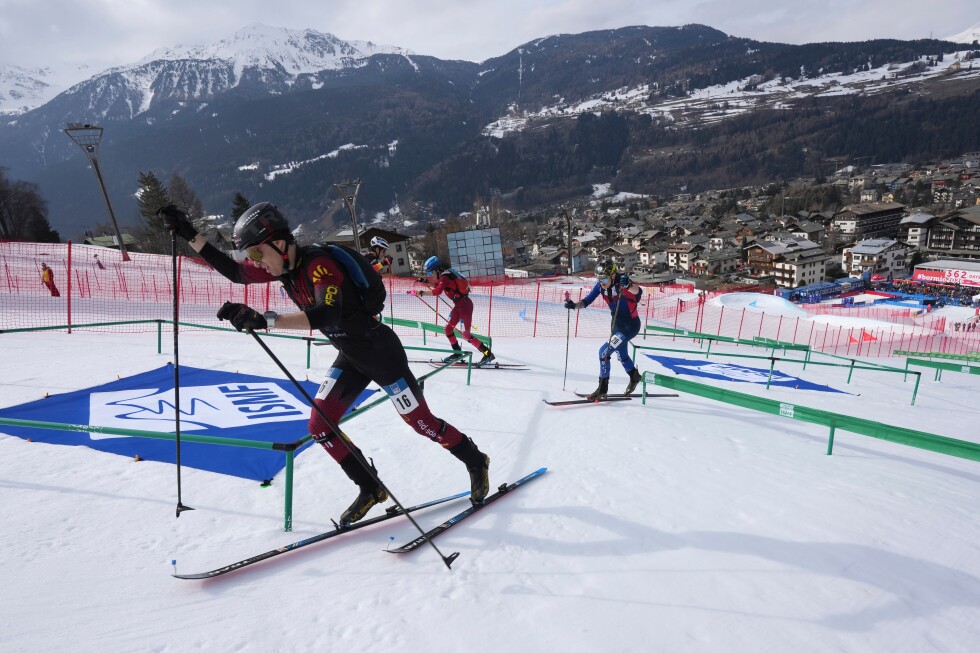
What is ski mountaineering aka skimo?
Ski mountaineering makes its Olympic debut on Feb. 19 (women’s and men’s sprints) and Feb. 21 (mixed relay) in Bormio, about 125 miles (200 kilometers) northeast of Milan.
In the simplest terms, ski mountaineering — also known by its shortened name, skimo — involves athletes climbing up a mountain and skiing down it.
Cameron Smith, who forms the U.S. team with Anna Gibson, described the sport this way: “It’s basically what skiing was before there were chairlifts.”
Smith and Gibson beat out Canada for the 12th and last Olympic skimo berth.
“Just to qualify for the Olympics would have been such a win for our team, and that’s really been our No. 1 focus for years now. And it felt like that was as far as we could dream — that just making it to the start line would be where our potential is,” said Smith, who trains out of Crested Butte, Colorado.
“We’re going there to be competitive and chase bigger and bigger dreams,” Smith told The Associated Press. “We’re allowed to dream of podiums and dream of medals.”
Will Lindsey Vonn and Mikaela Shiffrin pair up?
American stars Lindsey Vonn and Mikaela Shiffrin could form a formidable pair at Cortina d’Ampezzo when Alpine skiing introduces its team combined event, in which one racer does a downhill run and the other does a slalom run and the times are added together. If Vonn is able to compete, that is. Vonn, 41, is a downhill star who won gold in that event at the 2010 Vancouver Olympics. She ruptured her left knee’s ACL in a crash last week but said Tuesday she is confident she’ll be able to race at these Games. Shiffrin, 30, is a slalom star who was 18 when she became that event’s youngest Olympic champion at Sochi in 2014. The women race on Feb. 10; the men’s combined is Feb. 9 at Bormio.
Female ski jumpers compete on the large hill
Women who began competing in Olympic ski jumping at the 2014 Games on the normal hill will also be on the large hill for the first time. Medals for that new event will be determined Feb. 15 at the Predazzo Ski Jumping Stadium. Another change for this sport: The men’s so-called super team event involves two athletes instead of the four that competed in the previous team format.
Freestyle skiing adds dual moguls
Freestyle skiing is bringing in dual moguls for women and men — basically the same sort of judging based on technique, flips and twists, plus speed, as the existing moguls event, but with two athletes going down the hill in adjacent lanes. The women’s dual moguls is on Feb. 14 at Livigno Aerials and Moguls Park; the men do it the next day at same site.
Skeleton and luge bring new events
A women’s doubles event will debut in luge, with the first of six training runs on Feb. 8 and medals determined on Feb. 11 at the Cortina Sliding Center. At the same site, skeleton is adding a mixed team event that combines times for one woman and one man. That’ll happen on Feb. 15, the sport’s last day at these Olympics.
___
Video journalist Brittany Peterson in Denver contributed.
___
AP Olympics: https://apnews.com/hub/milan-cortina-2026-winter-olympics
