


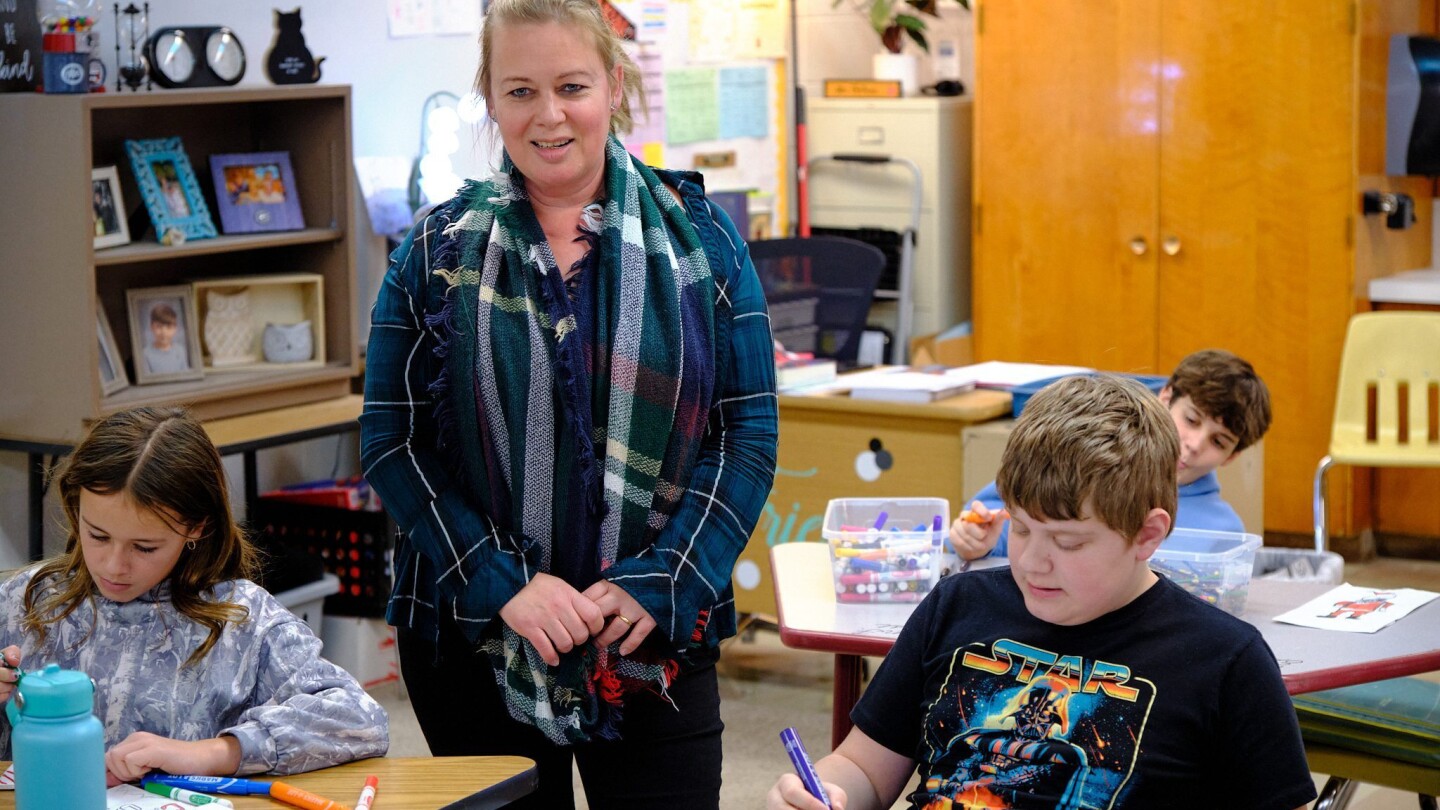
Winter break at Morningside Elementary in Great Falls is a reprieve from what has been a whirlwind two years for the school. It’s in the middle of its second year as a public charter school that embeds college students earning teaching degrees over three years within a functioning elementary school.
The college students take classes taught by Morningside’s K-6 teachers, as well as specialists like the librarian and music teacher. Those college students also work as paid teaching assistants, a role that incorporates the coursework toward their degrees. Their tuition, at least so far, has been covered by grants.
It’s known as the CORE School at Morningside. Great Falls Public Schools hopes the program will become a pipeline for young, credentialed teachers to join the district, already equipped with years of experience working in a school.
Recruitment will begin in the spring for the third year of the program, which was built nearly from scratch after Montana legislators approved new charter school legislation in 2023. The program is a partnership between GFPS and the University of Montana-Western in Dillon.
Already, the waiting list of prospective college students wanting to get their education degree at Morningside Elementary has nearly 30 names.
“It’s been an incredible journey,” said Marni Napierala, the program’s coordinator. “It’s the pride of my career, for sure.”
Napierala is the Great Falls-based liaison for UM-Western, but she’s a former GFPS educator of nearly three decades. Years ago, she worked for Montana State University-Northern, overseeing education students in Great Falls through a partnership with Great Falls College. Those students had some limited class time in local elementary classes, but it wasn’t immersive.
But the model intrigued Napierala. She thought that if college students could learn full-time at a real school, sort of like an apprenticeship, those students could be better equipped early in their teaching careers. And the existing elementary teachers, often strained by the demands of their profession, could have extra hands in their classrooms.
But launching a model like that always seemed too daunting a task.
“How do you make a school?” Napierala said. “That was always the barrier.”
In 2023, the Montana Legislature passed bills allowing local school districts to create their own charter school models. GFPS was among the first applicants to bring its proposal to state regulators. By then, the idea had grown among Great Falls district administrators like Rachel Cutler, GFPS elementary coordinator of curriculum and assessment, who worked with Napierala to coordinate with Estee Aiken, who in 2023 became dean of strategic initiatives at UM-Western.
“The genesis was just really amazing women saying, ‘Wait, can we do this,’” said Katrina Kennett, an education professor at UM-Western and faculty lead of the degree program.
GFPS submitted its public charter application to the Montana Board of Public Education in the fall of 2023. The application proposed a model for the district to “grow our own” elementary teachers. At the center of the model was a three-year degree program that put the college students in schools the entire time, longer than a residency might be in a traditional education degree.
Kennett told Montana Free Press that traditionally, college students learn the theory of education but aren’t given as many opportunities to see the daily grind of teaching. For teachers early in their careers, Kennett said that bringing that theory into the daily classroom environment can be challenging.
This immersive model at Morningside blends classroom theory with classroom experience.
“You get the immediacy and the skills to be able to work with what the day-to-day looks like,” Kennett said. “And you get that benefit of seeing the child development happening in front of you today.”
After the Montana Board of Public Education approved GFPS’ charter school proposal, the district looked toward fall 2024 as its first year under the CORE school model. (CORE stands for “Creation of teachers, Opportunities for students, Respect for the uniqueness of our community and Excellence in education.)
The entire teaching staff at Morningside had to be newly hired to work under the CORE school model, according to Principal Jennifer Martyn, who also applied and interviewed for her position and came over from Mountain View Elementary. The vast majority of the teachers came from within GFPS, and they’re required to hold a master’s degree in order to serve dual roles as elementary teachers and as UM-Western adjunct professors. The adjuncts went through the typical adjunct hiring process at UM-Western, Kennett said.
Great Falls district administrators worked to create an intricate coverage schedule that allows classroom teachers to step out to teach college kids during the school day. And they worked with UM-Western to develop the course curriculum.
“Our classroom teachers who are adjunct instructors have spoken about how it’s a lot of work for them,” said Cutler, the GFPS coordinator. “Especially because they’re creating their coursework for the first time through. But they’ve spoken about how energizing it is for them and their careers.”
The district also created a lottery system for the elementary students. Families within the typical Morningside district received priority placement, and about 200 of those students returned to the school. Another 100 came through families opting into the lottery to attend Morningside. Administrators told MTFP that the lottery was weighted to make Morningside similar to other schools in the district for the number of military students, those enrolled in free and reduced lunch programs, students with special needs and other demographics.
Martyn said that while most parents have become accustomed to the charter school model, the transition and new lottery system was a disruption for some who had already attended there.
“Some of the families who had been at Morningside, that change was hard for them,” Martyn said.
Elementary students cut the ribbon on the new CORE school on Aug. 27, 2024, a day before the school year started. Eleven college students began their degree programs alongside the back-to-school buzz of elementary school students.
The college program is called a “ sprint degree.” Students take many of their general education classes online through UM-Western, working straight through summers over the three-year program. During the school year, they primarily take their education classes from GFPS adjunct teachers and work as teaching assistants — a paid, part-time position — at the school. Part of the appeal, administrators told MTFP, is that the students don’t need to leave Great Falls. Some of those in the program wouldn’t be able to take off four years for the traditional college experience.
Daniela Pinneo has worked at GFPS for over a decade, primarily in special education at North Middle School. For a long time, she wanted to complete her education degree after immigrating from Romania and finding that only some of her previous higher education credits were transferrable to the United States. Now with her kids in high school, she thought the sprint degree was the right fit.
“I like the opportunity,” Pinneo told MTFP. “I know it was hard to transition to come to another school after nine years working and being comfortable where I was.”
Brooklyn Wood, 20, originally started school to pursue a certified nursing assistant program, but it didn’t feel right. In the past, she worked at a daycare and taught swim lessons to kids. When she learned about the sprint education degree program, she thought that working with kids sounded perfect.
“And I was like, it’s worth trying,” Wood said. “And I’ve never felt more at place with what I’m doing.”
Grant funding has covered the tuition for the sprint degree students in their first and second years. A sprint-degree grant from the Montana Office of Commissioner of Higher Education (OCHE) supported the first cohort of students who started in 2024, according to Kennett. The new group of 11 students, who began this fall, is supported by the “ Grow Your Own Educator Program,” also offered through OCHE.
In the fall of 2026, the first class of sprint degree students at Morningside will enter their third and final year of the program. Their tuition will then be supported by the Montana Teacher Residency Program through the state Office of Public Instruction, which also supports education students in traditional college programs.
“It provides them just enough to be able to go to work and do this,” Kennett said. “And that to me is so powerful when we think about access and these particular students.”
While the third-year residency grant is already a long-term program, stakeholders at both UM-Western and GFPS are looking for long-term grants to support future sprint degree students in their first and second years.
Once the students reach their third year in the program, they graduate from teaching assistants and become student teachers working in a classroom for the entire year. Next fall, Morningside will for the first time have a group of first-year program students in the same building as third-year students.
The logistics of scheduling and educating college and elementary students in one building can be daunting, administrators said. But they also spoke of a strong cohesion among faculty, staff and students’ families to make the program succeed.
“I walk into a lot of schools. There are committed people in all schools I go into,” Kennett said. “But having that coordination of commitment is special.”
___
This story was originally published by Montana Free Press and distributed through a partnership with The Associated Press.
