


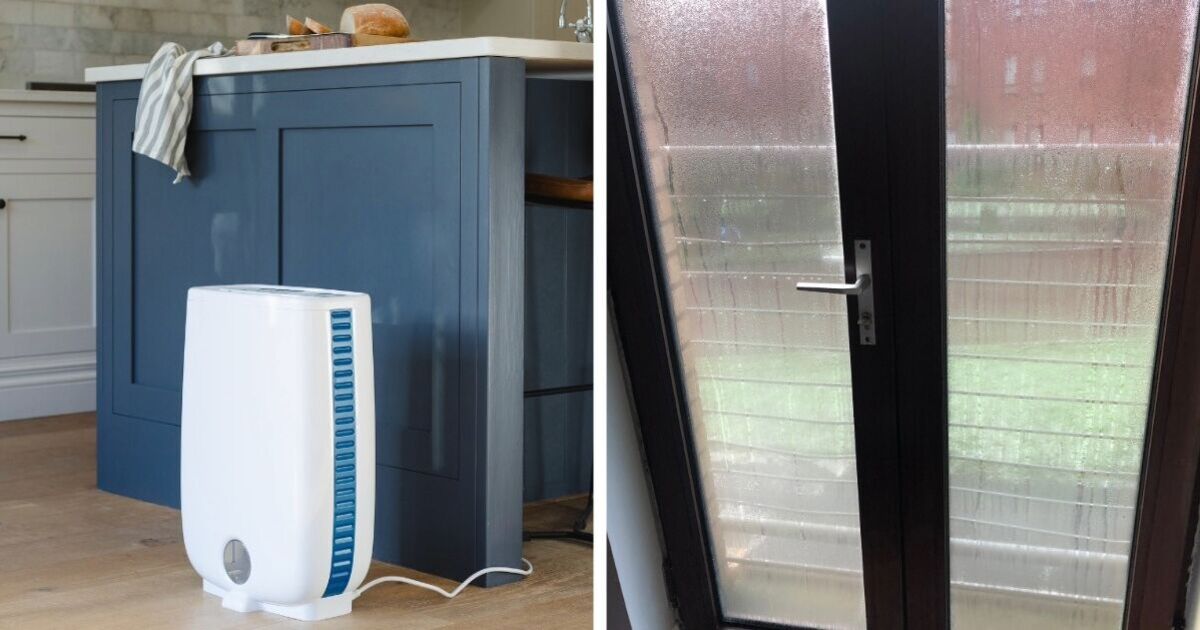

I splurged on a Meaco dehumidifier – my honest thoughts after five years (Image: Meaco/Ketsuda Phoutinane)
The overwhelming smell of the mouldy powder coating my ruby red slippers — a Christmas gift from another year — still makes my stomach turn.
It was just a few weeks before Christmas in 2020 — I was in the spare room when a peculiar black line on the wall caught my attention. Three-dimensional and squiggly, it resembled a thin worm emerging from the wall. Little did I know, this was just the beginning.
The squiggle of mould was just a preview of the cascade of black mould down the wall that had been hiding behind a cardboard box. The damp was so bad that a patch of paint about 10 inches wide had bubbled and distorted. Beneath it, the skirting appeared to be perspiring beads of black mould.
But the worst was yet to come. We traced the mould along the wall into the spare room’s closet. Illuminating the darkness with my phone, I discovered our belongings coated in a powdery, foul-smelling mould, akin to nuclear fallout — and the aforementioned slippers.
Once everything had been sprayed, discarded, and cleaned, it was clear that more drastic measures were needed. Relocating wasn’t an option, and despite our tight budget, investing in a high-quality dehumidifier became a necessity.
After extensive research, I finally opted for the Meaco DD8L dehumidifier.
Why I bought dehumidifier — again
If you’ve ever grumbled about damp to a landlord, you’ll likely have been met with unhelpful advice to “just air the room out” or “turn on the radiator”, as though it were that straightforward. These simple solutions are often insufficient for buildings that are fundamentally unsuitable.
What I was unaware of at the time is that exterior walls are infamous for causing damp, particularly in inadequately insulated buildings that are all too common in the UK. Placing anything near (not even against) these chilly walls creates a damp pocket that fosters mould growth.
Regrettably, I had already discovered that items like shoes, rucksacks, and Ikea bedside tables could become breeding grounds for mould.
Read more: ‘Masterpiece’ BBC show is ‘everything a modern Western epic should be’
Read more: Fried eggs will cook ‘perfectly’ if you add 1 overlooked ingredient to pan
For those grappling with a mould-infested living environment, I have a solution — desiccant dehumidifiers. Most people will be familiar with the more affordable traditional dehumidifiers that passively absorb moisture from the air.
Prior to this, I tried the popular £12 Unibond Moisture Absorber and the £35 Pro Breeze dehumidifier, but they made no noticeable difference.
It wasn’t until the great Mouldmageddon of 2020 that I bothered to look into dehumidifiers properly and discovered the type that more effectively combats damp, mould, and condensation. Plus, desiccant dehumidifiers emit warm air, providing a touch of heat and faster drying laundry.
Many desiccant dehumidifiers cost over £100, with Meaco — a brand frequently mentioned on Which?, Good Housekeeping, Reddit, and Mrs Hinch Facebook groups — priced nearly £200. It was a big investment, especially considering our financial situation at the time, but we decided to take a calculated risk on it.
Meaco dehumidifier review after five years
For five consecutive winters, my Meaco dehumidifier (currently on Amazon for £159.99, £20 cheaper than when I bought it) has been performing admirably, earning my endorsement with the fervour of a newfound devotee.
Condensation
The difference would be noticeable to a passerby. The windows of neighbouring flats were awash with condensation, moisture that trickled and smeared down the panes, but not ours.
Using the dehumidifier nightly from October through March significantly reduced the condensation in the flat by at least half, often more.
It wasn’t a miracle cure. Despite the persistent struggle with mould and condensation, short of demolishing the wretched building and starting anew, the Meaco DD8L, which is recommended for flats or houses with up to five bedrooms, primarily benefits the room you put it in.
Damp and mould
We activated it on the lowest setting overnight, positioning it in the doorway between the spare room and hallway to mitigate the worst of the humidity and heat the chilliest part of the flat.

We discovered the paint had warped and powdery mould on our belongings (Image: Ketsuda Phoutinane)
During the day, we switched it on as required in the open-plan kitchen/living room where damp was prevalent (we once discovered mould growing in the crevices of a ceramic plate), or stationed it next to the laundry rack.
Heating
Unexpectedly, it proved to be a godsend for drying laundry, reducing the drying time from four days to two. It also contributed to heating bill savings by emitting a consistent flow of warm air.
Noise
In general, desiccant dehumidifiers are less noisy than their compressor counterparts, which is one reason why we opted for the former. On its lowest fan setting, it produces a mild white noise effect, and I had no issue sleeping through the night with it on.
The noise increases with the medium setting, and the highest fan setting (marked with a laundry symbol) is rather loud.
Specifications
The Meaco DD8L offers three fan settings (including a turbo-charged laundry setting), four humidity settings, and four timer options, allowing you to tailor it to your specific needs and budget. According to Meaco, it costs 8p an hour to operate on the lowest fan setting, based on 27.03p/kWh.
Once the desired level is achieved, the humidifier will automatically switch off and check the humidity every half an hour, turning itself back on as required.
All things considered, it managed to collect a full 8L tank of water roughly every other day. Pouring all that water down the drain is immensely gratifying.

The Meaco dehumidifier worked where cheaper models didn’t (Image: Meaco)
Cons
The only drawback we’ve encountered is that it can leak sporadically, perhaps about 5% of the time. This issue comes and goes, and we haven’t determined the cause.
We place a few paper towels beneath it as a precaution.
The Meaco DD8L dehumidifier is available for purchase on Amazon.
What are compressor or desiccant dehumidifiers?
In short, a compressor dehumidifier operates by creating a cool surface. When the warmer, moist air in the room encounters this surface, condensation occurs and the water is extracted.
This explains why compressor dehumidifiers are less effective in cooler rooms, as the interior of the dehumidifier needs to be chillier than the surrounding air.
On the other hand, desiccant dehumidifiers function consistently regardless of the room’s temperature. They contain a desiccant wheel that soaks up moisture from the air, much like a sponge.
The reason they release warm air is due to the desiccant being reactivated by an internal heater and fan.
Here’s a guide from Meaco based on the average temperature of the room where you plan to use it:
Below 10°C: desiccant dehumidifier onlyBetween 10°C and 15°C: desiccant dehumidifier or a large compressor dehumidifier (20L or 25L)Above 15°C: desiccant dehumidifier or any size compressor dehumidifier (10L, 12L, 20L or 25L)As a rule of thumb we would always recommend a desiccant dehumidifier if the room temperature is below 10°C, a desiccant dehumidifier or a large compressor dehumidifier (either a 20L or 25L) if the room temperature is between 10°C and 15°C and any type of dehumidifier, including a small compressor dehumidifier (10L or 12L), if the room temperature is above 15°C.
