


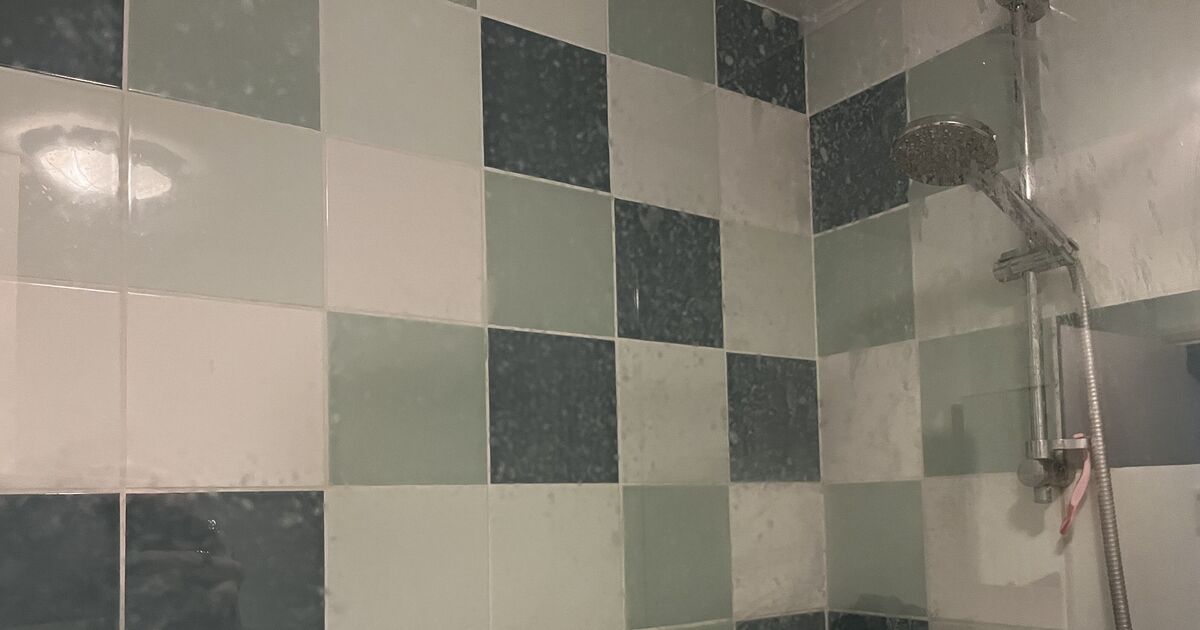

I tested out two natural items to clear my shower of hard water stains and soap scum (Image: Ellen Jenne)
It’s that time of the year when I tell myself I need to get myself in order, and with that, have a New Year reset. Not only with myself but with my surroundings.
I’ve just spent my first Christmas in my new flat, and with December being so chaotic, January seemed to be the perfect time to get ahead. Cleaning can be one mammoth task so I try to do bits as I go along, but if there’s anything to make my life easier, I’ll give it a try. One of my favourite home hacks TikTok creator Chantel Mila swears by a minimalist approach to cleaning hard water stains on shower glass.
READ MORE: Bathroom floors will be dust-free in minutes when using ‘life-changing’ item
READ MORE: Microwaves will be sparkling and smell great when wiped with a natural item

Chantel’s go-to is white vinegar and clove oil (Image: Ellen Jenne)
The base of the cleaning solution is one cup of white vinegar with the addition of 10 drops of clove oil. Living in London, hard water marks are a constant battle. So much so, I tend to ignore them, because no matter how often I scrub them off, they will always come back.
Hard water stains appear because it contains high numbers of minerals like calcium and magnesium. Once the water evaporates, it leaves behind minerals as chalky, white deposits.
Over time these hard water marks can build up even more and turn into full-on limescale. Chantel’s answer is to combat it with vinegar and clove oil.
White vinegar makes a really good household cleanser due to its acidity, specifically its acetic acid content. This makes vinegar good at dissolving dirt, grease, grime and killing bacteria, all of which can be found in soap scum.

Hard water stains are such a common problem to deal with in London (Image: Ellen Jenne)

Chantel claimed the multi-purpose spray can be used to clear mould spots too (Image: Ellen Jenne)
The addition of clove oil can also help clean and remove mould thanks to its antifungal properties, specifically its eugenol content. Eugenol is a natural phenolic compound.
Eugenol is widely used as a flavouring agent in food, cosmetics, and perfumes, but it is also used for its anaesthetic, antiseptic, and analgesic properties in medicines. Adding clove oil into the mixture can also help cover up the stench of white vinegar, which is also a plus.
However, I’m not overly fond of clove aroma. Yes, it does bring back the nostalgia of the festive season, but spices just aren’t my go-to scent of choice.
While Chantel uses the mixture in a spray bottle, I just mixed the two together in a jug and slathered the solution on with a sponge. The potency of both ingredients clashed together constantly, so if you have a sensitive nose beware.

One layer got rid of the hard water marks, but another round would help to rid soap scum better (Image: Ellen Jenne)
Almost immediately the solution dissipated the stains, not just washing them off with water. Once the inside of the shower glass was clear, the stains on the other side could no longer hide behind the mask.
I repeated the same procedure on the outside of the shower glass, leaving the solution to work its magic before rinsing off with hot water. Drying the water off with some kitchen towel and a tea towel, the results were unmissable.
It worked a treat, only leaving a few marks of soap scum on the glass. Since this was only one layer, I don’t doubt a second round would cut through the grime.
Chantel also claimed it could be used as a mutli-purpose get rid of the dark mould and soap scum in the bathroom. Fortunately, there aren’t many mould spots in my bathroom, but I gave the corners where there’s the most build-up a good douse, leaving the solution to do its work.

The difference between the before and after was like night and day (Image: Ellen Jenne)
I also applied the solution to the soap scum stains near the shower drain and sink. Again with a little bit of elbow grease, the solution managed to cut through the light layers of soap scum.
The shower required a little more pressure, but it definitely worked. Having left the solution to burrow into the dark shower in the shower, I repeated my scrubbing.
However, this seemed fruitless. The mould spots didn’t seem to be affected by the white vinegar solution at all. Chantel’s instructions did appear to indicate how long it would take for the mould to disappear, but for now they remain unbothered.
When it comes to hard water, white vinegar is certainly a good natural alternative to chemical cleaning products. For mould spots, however, I think something stronger is required.
