


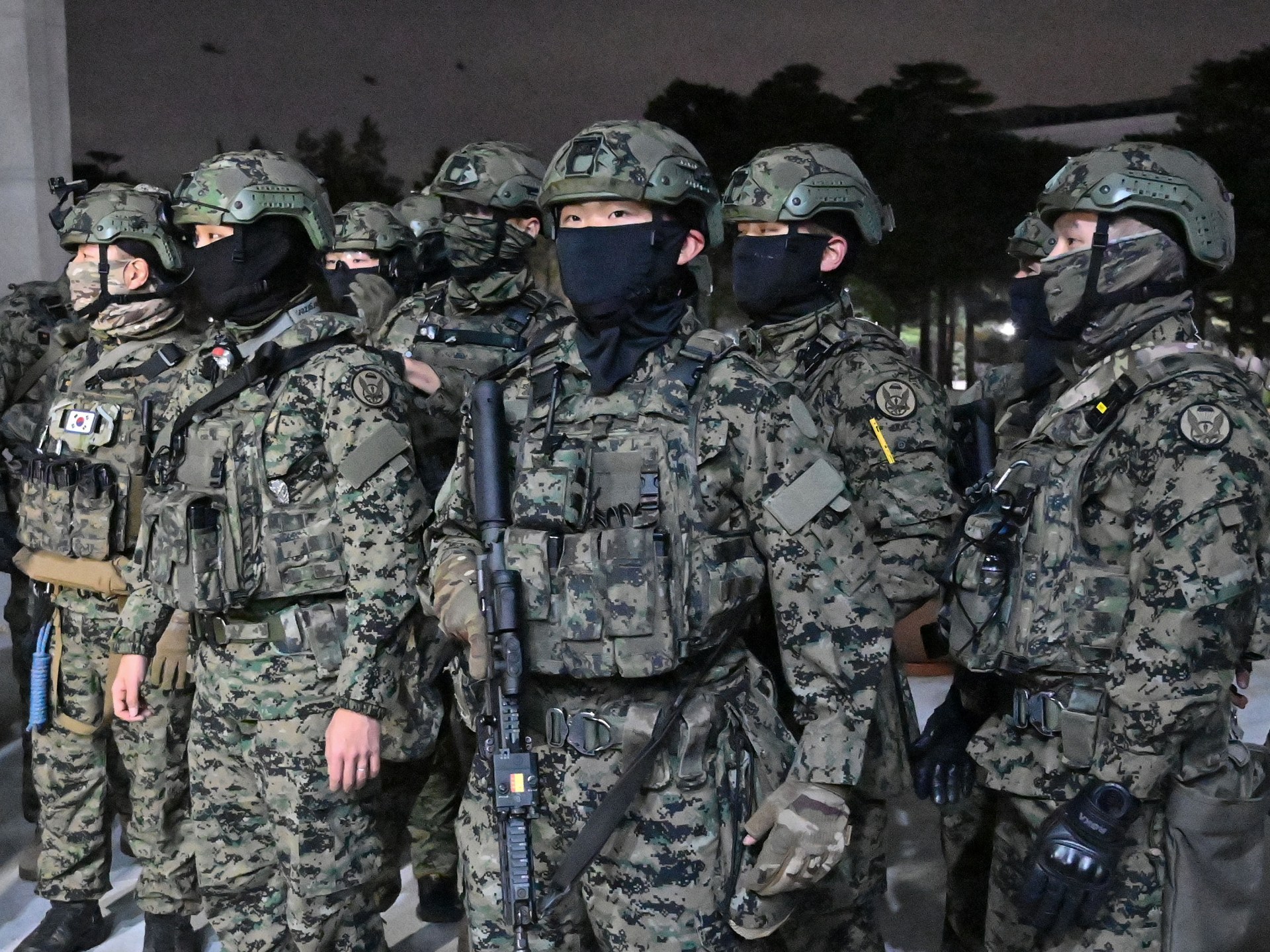
One year ago, on December 3, 2024, South Korea was thrust into a political crisis after then-President Yoon Suk-yeol declared martial law, citing rising unrest and an alleged threat to national security.
Troops were deployed, Yoon ordered the detention of opposition lawmakers, and key state institutions, including the National Assembly, were placed under military command. Press freedoms were also curtailed, though journalists continued reporting in defiance of the restrictions, and citizens mobilised to demand an end to the decree.
Recommended Stories
list of 3 itemsend of list
The move prompted widespread demonstrations and, within just six hours, the parliament was surrounded by protesters and police as politicians voted against the decree, forcing Yoon to withdraw it.
Within days, the Supreme Court declared the brief martial law unconstitutional. Weeks later, the president was impeached and removed from office, ending an extraordinary moment in South Korea’s democratic history.
Yoon later issued a public apology for the “anxiety and inconvenience” he caused.
But elsewhere, the story often unfolds very differently.
Several countries remain under martial law or effective military rule, with wide-ranging implications for civil liberties, political opposition and daily life.
So, where does martial law exist today and what does it mean for the people living under it?
What is martial law?
Martial law is an emergency system of governance in which the military assumes authority over some or all civilian functions.
Depending on the country, this can involve the suspension of constitutional rights, curfews and movement restrictions, military trials for civilians, expanded arrest and detention powers, restrictions on media and assembly, and more.
Sometimes, it also includes the temporary replacement of civilian institutions with military administrators.
Governments usually justify martial law on grounds of war, mass unrest, armed rebellion or a threat to national stability. Rights groups, however, warn that it is often used to suppress dissent, consolidate power or sideline democratic processes.
Which countries are under some kind of military rule today?
Ukraine
Ukraine has been under nationwide, self-described martial law since February 24, 2022 – the day Russia launched its full-scale invasion of the country. But unlike how martial law is traditionally understood, Ukraine is governed by a civilian administration.
Ukraine’s situation is closer to what Vina Nadjibulla, vice president for research and strategy at the Asia Pacific Foundation of Canada, described as a “state of emergency, where governments activate special powers – such as curfews, bans on gatherings, or expanded policing – but within a constitutional framework that keeps civilian institutions, including parliament and the judiciary, formally in charge”.
Nevertheless, under the martial law decree, the Ukrainian government has granted extended powers to the armed forces, banned men of fighting age – typically those aged 18 to 60 – from leaving the country, and restricted political activity deemed harmful to the war effort.
Public gatherings also require approval, and media outlets must comply with rules intended to protect national security. These include prohibiting the publishing of reports on air defence systems, and banning footage of missile launches.
The restrictions are broadly accepted by much of the population, but they have raised questions about political accountability and transparency in the country, especially as President Volodymyr Zelenskyy’s government faces growing accusations of corruption.
Ukraine’s martial law has also led to criticism for effectively eliminating political challenges to Zelenskyy, with some critics, including United States President Donald Trump, arguing that the country needs new elections.
Petro Poroshenko, a former president and leader of the largest opposition party, said earlier this year that while martial law was needed, Zelenskyy, according to him, was using the restrictions to strengthen his power.
“I want to stress that we should recognise the obvious – the government has started to abuse martial law, using it not only to defend the country, but to build an authoritarian regime,” Poroshenko said during parliamentary debates in April.
Myanmar
Myanmar’s army seized power in a February 2021 coup, overthrowing the elected government of Nobel Laureate Aung San Suu Kyi. The military government has since declared martial law in dozens of townships, especially in major cities like Yangon, Mandalay and conflict-hit ethnic regions, granting commanders sweeping powers to detain, try and execute civilians in military courts.
The military’s campaign against anti-coup resistance has plunged parts of the country into full-scale civil war. Internet blackouts and mass arrests have been documented across martial law zones.
“Military commanders have taken over local administration, civilian courts have been sidelined, and open criticism of the regime or its proposed elections can lead to harsh punishment,” Nadjibulla said, describing Myanmar as the “clearest example [of martial law] in the Asia Pacific”.
Rights groups, including Amnesty International, say that more than 6,000 people have been killed and tens of thousands detained since the coup. For many communities, daily life involves checkpoints, curfews and the constant threat of raids or air strikes.
The army has bombed schools, hospitals and religious buildings with total impunity, Amnesty said, in “widespread and systematic attacks against the civilian population nationwide”.
In late July, the military announced that it was lifting the state of emergency from some parts of the country, ahead of national elections scheduled for December 28.
But some 22,689 political prisoners, including Aung San Suu Kyi, remain in detention as of December 2, according to the Assistance Association for Political Prisoners, an independent organisation that keeps detailed tallies of arrests.
The United Nations has warned that the “military-controlled” elections at the end of the year are unlikely to lead to any democratic transition, and might only “ingrain insecurity, fear and polarisation throughout the country”. Major political parties are barred from contesting the vote.
Thailand
Thailand is not under nationwide martial law, but specific areas along the country’s southern provinces, including Pattani, Yala and Narathiwat, remain under longstanding emergency and security laws that grant the military expanded powers, similar to martial law.
These measures allow sudden searches, broad arrest powers and heavy military presence as the government continues to combat a longrunning armed rebellion.
Thailand has recently also declared martial law in the border districts of Chanthaburi, Trat, and Sa Kaeo provinces following clashes with Cambodia.
The declaration was made to safeguard “national sovereignty, territorial integrity and the lives and property of Thai citizens”, a statement by Apichart Sapprasert, commander of the Border Defence Command, said in July.
Burkina Faso
Burkina Faso has been under military rule since twin coups that the country underwent in 2022, first in January, then again in September.
Since then, while the government has not declared nationwide martial law, the country’s military leaders exercise full executive and legislative control, with restrictions on political parties, and curfews are frequently imposed during security operations.
The military claims its takeover was necessary to restore stability amid escalating attacks by various armed groups. But censorship, arrests of critics and limits on public assembly have tightened over the past year, according to rights groups.
The European Union and United Nations, among other bodies, have accused Burkina Faso of serious human rights violations in its fight against armed groups, including the indiscriminate killings and forced disappearances of dozens of civilians, among them journalists and human rights defenders.
Guinea
Guinea’s military seized power in September 2021, suspending the constitution and dissolving parliament. Although martial law is not formally in place, the military government rules by decree.
Demonstrations have been repeatedly banned, and security forces have been accused of using lethal force against protesters demanding a return to civilian government.
Opposition figures face travel bans and arrest threats, and the transition timeline has been repeatedly pushed back.
In September, voters in Guinea overwhelmingly backed a new constitution that could allow coup leader Mamady Doumbouya to run for president if he chooses to.
Critics called the results a power grab, but the military government said the referendum paves the way for a return to civilian government. The presidential election is currently expected to take place later this month.
A charter adopted after the coup barred members of the transitional government from seeking office.
The country’s two main opposition leaders, Cellou Dalein Diallo and deposed former President Alpha Conde, are among those who called for a boycott of the referendum.
Their political parties are currently suspended, and Human Rights Watch has accused the government of disappearing political opponents and arbitrarily suspending media outlets.
Guinea-Bissau
Guinea-Bissau slipped under military control in late November 2025, after soldiers seized the election commission just as presidential results were due. According to the commission, ballot papers, tally sheets and even the data servers were destroyed, making it impossible to finalise the count.
The army then installed Major-General Horta Inta-A as a transitional leader under a new “High Military Command”, dissolving civilian authority, and imposing curfews and bans on protests and strikes.
Guinea-Bissau’s new military authorities are facing growing pressure from the Economic Community of West African States (ECOWAS) to restore constitutional rule and allow the election process to resume.
Madagascar
Madagascar has lived under some form of military-backed governance since 2009, when Andry Rajoelina, then a former mayor supported by key army factions, seized power in a coup that set the tone for years of political instability in the country.
Although several elections have since been held, the military remains a central political actor, often intervening during periods of tension or protest.
That pattern resurfaced in October 2025, when weeks of youth-led demonstrations over corruption and economic frustration prompted the elite CAPSAT military unit to defect and take control of the capital.
As the government collapsed, the army forced out President Rajoelina and installed CAPSAT commander Michael Randrianirina as interim leader.
The military leadership suspended most national political institutions and the constitution, forming a Council of the Presidency for the Refoundation of the Republic of Madagascar.
Randrianirina’s military takeover has been condemned by the United Nations and by the African Union, which suspended Madagascar’s membership.
Are other countries veering towards martial law?
Though both are ruled by civilian administrations, the interim governments that came to power in Bangladesh (2024) and Nepal (2025) after their leaders were overthrown rely heavily on the military, Nadjibulla pointed out.
In Bangladesh, Prime Minister Sheikh Hasina was ousted in August 2024 after a mass uprising against her rule that intensified following a bloody crackdown on protesters. “Because the police and civilian security services were badly discredited during the unrest, the army has remained highly visible across the country since mid-2024,” Nadjibulla said. “The interim authorities are ruling mainly through executive decrees while preparing elections, with the military acting as a key guarantor of order and of the transition itself.” Bangladesh is poised for elections in February.
In Nepal, Prime Minister KP Sharma Oli had to leave office in September 2025 amid youth-led protests.
An interim administration “took office through procedures that stretched the constitution,” Nadjibulla said. “Human rights groups have reported extensive use of force by police and, in some instances, by army units. This is not martial law on paper, but it shows how quickly security institutions can become the decisive political players in periods of crisis.”
