


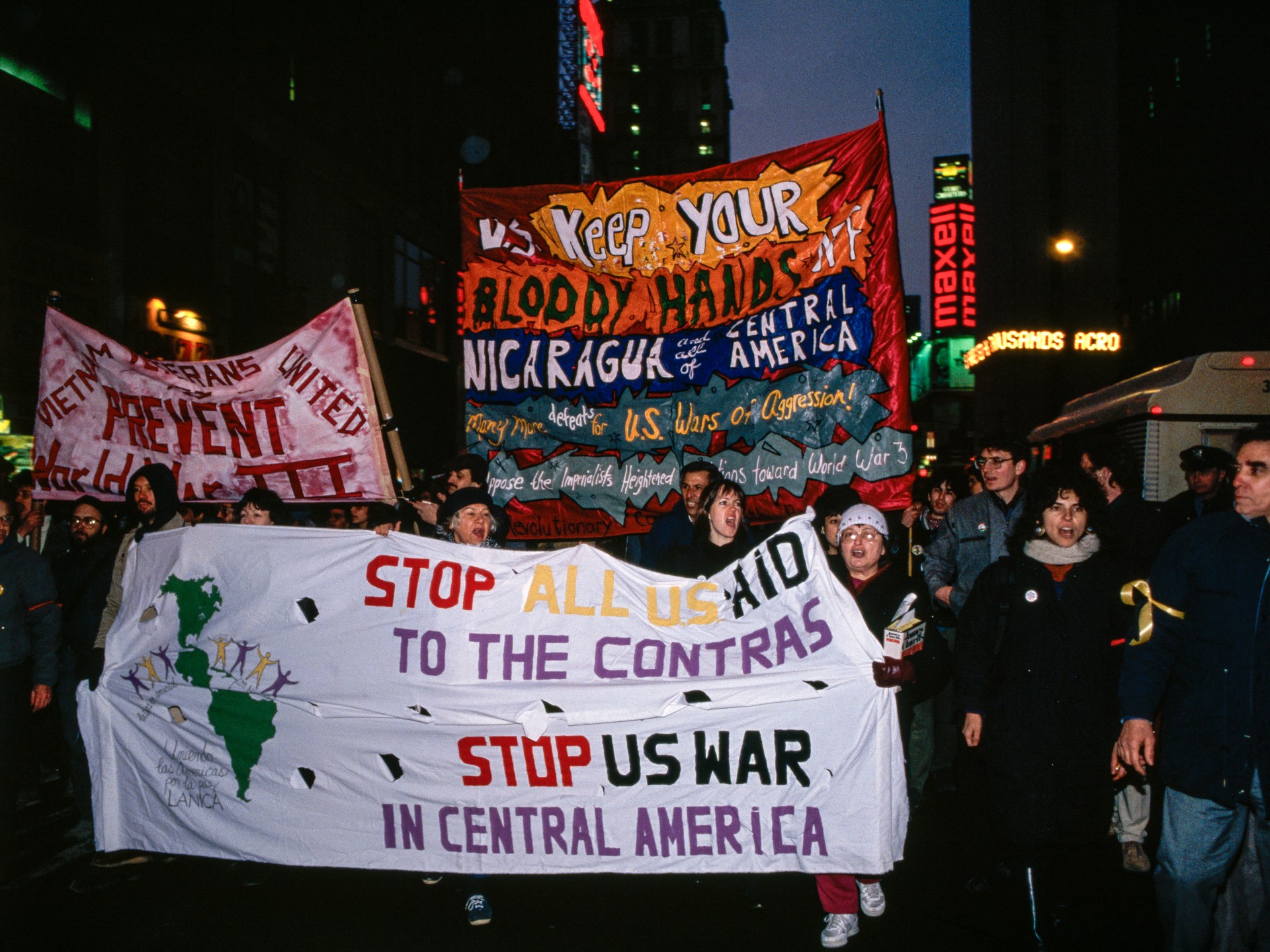
As the United States ramps up strikes on Venezuelan boats and threatens a land invasion to fight alleged drug trafficking networks, President Donald Trump has pardoned Honduras’s former President Juan Orlando Hernandez and released him from a 45-year prison sentence in the US for weapons and drug trafficking offences.
Since September, US military strikes on at least 21 Venezuelan boats in the Caribbean and eastern Pacific have killed more than 80 people. The Trump administration claims these boats were trafficking drugs to the US but has not backed these allegations with any evidence.
Meanwhile, the US itself has a long history of leveraging narcotics smuggling and drug gangs to support its foreign policy goals in various parts of the world, beginning with the 19th-century Opium Wars with China.
Is the US really fighting a drug trafficking crisis in Venezuela?
Cocaine production hit a record 3,708 tonnes globally in 2023, according to the United Nations Office on Drugs and Crime (UNODC).
However, it found that cocaine originates in Colombia, Peru and Bolivia, and most US-bound cocaine routes go through Colombia, Peru and Ecuador, not Venezuela, which serves as only a minor transit corridor.
The US Drug Enforcement Administration (DEA) reported last year that 84 percent of US-seized cocaine comes from Colombia and did not mention Venezuela as a source.
If Trump wants to clamp down on drugs, why did he pardon Hernandez?
US President Donald Trump pardoned the drug conviction of Juan Orlando Hernandez, the former president of Honduras and member of the country’s right-wing National Party, on November 28.
On Monday this week, Hernandez was released from his 45-year prison sentence at the high-security facility of USP Hazelton in West Virginia in the US.
Hernandez had been extradited to the US in 2022 and was found guilty of conspiring to import cocaine to the US and of possessing machineguns, in 2024.
Justifying his decision to pardon him, Trump said Hernandez had been “treated very harshly and unfairly” in a social media post on Friday.
However, some observers believe this shows that Trump’s real objective in targeting Venezuela is a desire to unseat the country’s left-wing president, Nicolas Maduro, who is accused by the US of having links to drug cartels and of even overseeing drug trafficking networks. The US recently raised a reward for information leading to Maduro’s arrest to $50m.
How has the US been involved in drug trafficking in the past?
The US has been accused of making use of drug trafficking networks to support its own aims at many points throughout history.
We take a look at nearly two centuries of US involvement in drug trafficking.

1800s: The Opium Wars
Trump has accused China of flooding the US with fentanyl in recent years, and has used the threat of trade tariffs to force it to cooperate in preventing the trafficking of this highly addictive opiate drug.
But 200 years ago, Western imperial powers such as the United Kingdom, France and the US were pushing opiates in the other direction in a bid to expand their influence through trade.
The imperial powers were facing a trade imbalance with China due to high demand in the West for Chinese goods such as tea, porcelain and silk.
Desperate to reverse this imbalance, British merchants began to smuggle Indian-grown opium into southern China. Soon, American traders had also turned to opium to boost their own exports to China.
In 1839, Chinese forces attempted to crack down on the inflow of opium, confiscating and destroying it and marking the beginning of the First Opium War. The British and Chinese engaged in naval conflict and the British emerged victorious in 1842. While the US did not militarily engage in the war, American traders were active in China and brought limited amounts of opium from Turkiye and India.
In 1844, the US and China signed the Treaty of Wanghia, their first treaty together. While this treaty ostensibly outlawed the opium trade, in practice, it opened up five ports for Western-Chinese trade in Guangzhou, Xiamen, Fuzhou, Ningbo and Shanghai, enabling US traders to expand their sales of opium.
The Second Opium War took place 20 years later, from 1856 to 1860. French and British forces fought with diplomatic assistance from Russia and protection from American forces. Under pressure, China was forced to sign a treaty legalising opium, one of Britain’s main demands.
1960s-1970s: In Laos during the Vietnam War
Between 1955 and 1975, the US was engaged in armed conflict in Vietnam and parts of neighbouring Laos and Cambodia in a war between the communist North Vietnam, backed by the Soviet Union and China, and anti-communist South Vietnam, backed by the US.
During this time, the US Central Intelligence Agency (CIA) ran covert operations in Laos, which is northwest of Vietnam, to counter communist forces in Southeast Asia.
In Laos, CIA officers trained militias from Indigenous tribes such as the Hmong people in the mountainous north, according to a 2003 document published by the CIA, to fight against North Vietnamese forces in Laos, as well as against Laotian communists, the Pathet Lao.
At the time, the Hmong were heavily economically reliant on the cultivation of opium poppies as a cash crop.
According to historian Alfred W McCoy, who wrote the 1972 book, The Politics of Heroin in Southeast Asia, the CIA covertly operated an airline called Air America to transport opium from remote mountain areas to be sold in Southeast Asia and international markets, including the US. The proceeds were used to support the militias.
McCoy presented the findings of his book during a 1972 congressional testimony before a Senate subcommittee. The CIA has never formally admitted direct involvement in the drug operation.

1980s: During the Soviet-Afghan War
The Soviet army invaded Afghanistan in 1979 to support a communist government that was facing internal threats. Between 1979 and 1989, the Soviet Union fought Afghan rebel fighters, the mujahideen.
Poppy cultivation thrived in mujahideen‑held provinces such as Helmand in southern Afghanistan and Nangarhar in eastern Afghanistan. Historians, including McCoy, allege that CIA-backed mujahideen fighters financed much of their war efforts through opium cultivation and trafficking. Trafficking routes went through Pakistan and Iran, feeding both European and Middle Eastern markets.
The Soviet-Afghan War resulted in one of the sharpest spikes in global heroin supply in the late 1980s. A UNODC report in 2001 found that in 1999, Afghanistan was producing 79 percent of global illegal opium.
A CIA report from 1986 also alleges that there was widespread use of drugs among Soviet troops in Afghanistan, and that those soldiers smuggled drugs back to the Soviet Union.
The CIA has never publicly admitted to backing opium cultivation and trafficking in Afghanistan.

1980s: Post-Afghan War spillover in Pakistan
Following the Soviet invasion of Afghanistan in 1979, the CIA partnered with Pakistan’s Inter‑Services Intelligence (ISI) to arm the Afghan mujahideen as part of Operation Cyclone.
The war economy boosted heroin production in Afghanistan’s Golden Crescent region – the region spanning Afghanistan, Pakistan and Iran. Pakistan’s tribal belt, especially provinces Balochistan and modern-day Khyber Pakhtunkhwa, became transit corridors for heroin exports to the West.
1980s: The Iran-Contra Affair
From the 1950s until the 1980s, the CIA backed local efforts to clamp down on communist forces in Latin America.
In Nicaragua, the CIA backed a right-wing group called the Contras, who were fighting the left-wing Cuba-backed Sandinista government during the 1980s. In 1985, then-US President Ronald Reagan heaped praise on the Contras, calling them “the moral equivalent of our founding fathers”.
However, this all took place against the backdrop of another war overseas that the US took an interest in.
From 1980 to 1988, Iran and Iraq fought a war, which began with Iraq’s invasion of Iran. In 1985, Iran secretly requested to buy weapons from the US. At this time, an arms embargo prevented the US from openly selling weapons to Iran.
The Reagan administration nevertheless sold Iran the weapons so that the US could strengthen its position in the Middle East and secure the release of American hostages, mostly diplomats and missionaries, who were being held by Hezbollah in Lebanon.
While Reagan had initially publicly denied selling weapons to Iran, he later admitted that the weapons had been sold to secure the hostages’ release.
Around the same time, the US Congress passed the Boland Amendment, which restricted US involvement in foreign countries and banned US funding for the Contras. To get around this, members of the National Security Council diverted profits from the Iran arms sales to fund the Contras without congressional approval.
In his 1998 book, Dark Alliance: The CIA, the Contras, and the Crack Cocaine Explosion, US investigative journalist Gary Webb traced links between Contra supporters and the crack cocaine epidemic in Los Angeles.
Webb wrote that a group affiliated with the Contras smuggled cocaine into the US, which was then sold as crack cocaine in Los Angeles – ultimately triggering the epidemic. The funds generated were then used to support the Contras. Webb claimed that the CIA knew about these transactions and backed them.

1970s-1980s: During the Manuel Noriega era
Manuel Noriega was a military dictator who ruled Panama from 1983 to 1989.
Noriega had been a CIA informant and asset since the 1960s. He shared intelligence with the US about Latin American political movements, as well as Soviet and Cuban activities in the region.
Simultaneously, Noriega is alleged to have been a facilitator for Colombian drug cartels, particularly the cocaine ring, the Medellin Cartel, enabling the shipment of cocaine through Panama. At the time, Medellin was said to be responsible for more than half of the cocaine smuggled into the US, according to local media reports.
Noriega’s intelligence cooperation with US agencies continued until he was indicted in 1988 by the US Justice Department on multiple charges, including drug trafficking, racketeering and money laundering.

1980s-1990s: In Haiti during the coup period
During the late 1980s to mid‑1990s, Haitian politics were mired in turmoil. A succession of coups, military rulers and short‑lived democratic governments destabilised the country.
During this time, several Haitian military and police officials with ties to CIA intelligence networks were accused of facilitating cocaine trafficking into the US.
These officers allegedly worked as intermediaries for Colombian cartels, using Haiti as a port of transshipment for cocaine into Florida and other parts of the US.
Have US soldiers been accused of drug trafficking?
Yes, there have been instances when US soldiers have been accused of trafficking drugs.
This year, investigative reporter Seth Harp’s book, The Fort Bragg Cartel: Drug Trafficking and Murder in the Special Forces, was published, revealing details about murders, drug trafficking and deep corruption among US Special Forces at Fort Bragg over the past decade.
In 2023, at least 17 service members of the United States Forces Korea (USFK) were arrested for smuggling drugs in South Korea. There has not been a public update about this.
In 2005, four US soldiers who were on an anti-narcotics mission in Colombia were held on drug trafficking charges after 15kg (35lb) of cocaine was found on their military aircraft. There has not been a public update about this.
