


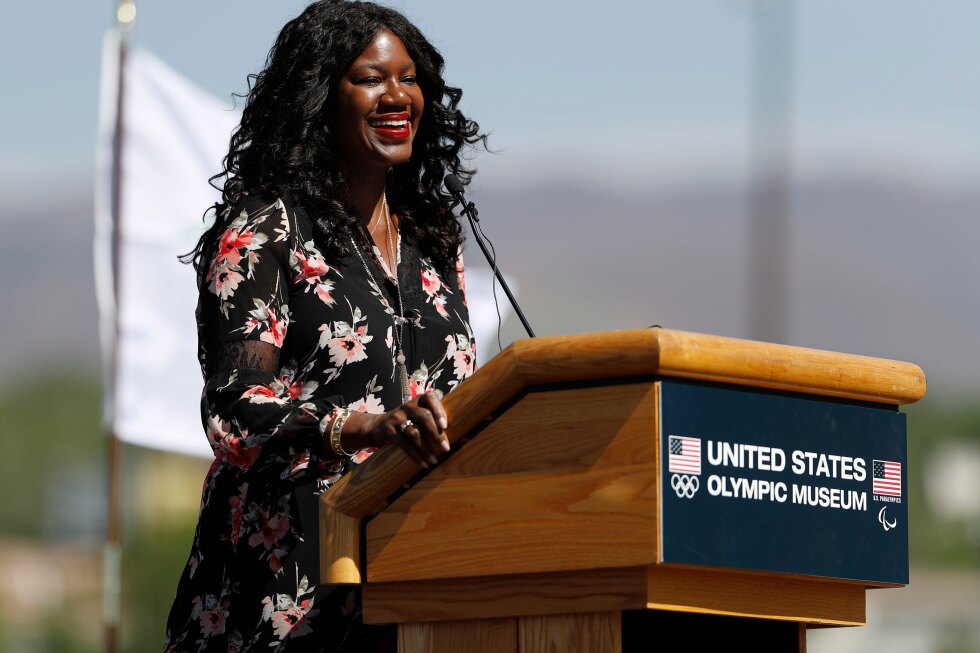
DENVER (AP) — Benita Fitzgerald Mosley has stood at the top of the podium at the Olympics. She’s been part of fix-it projects and start-ups in that world, as well.
None of those roles have presented the challenges she’ll face in her new job — CEO of the U.S. Center for SafeSport. It’s a post she officially takes over Sunday in hopes of redirecting an organization charged with combating sex abuse in Olympic sports that has been bombarded with problems, both internal and external, over most of its nine-year history.
“It’s a hard job,” Fitzgerald Mosley said in an interview with The Associated Press during a trip this week to agency headquarters in Denver. “On its surface, it probably would scare any normal human to death.”
But, she said, the center’s mission aligned with some of her personal goals involving everything from faith to helping people maximize their potential. And, she said, “I feel like it’s a calling.”
“The more I went through the interview process, the more I felt, ‘You should really do this job. This is you,’” she said.
Before the Olympics, a background in engineering
Her Olympic accolades include winning the gold medal at the 1984 Los Angeles Games, where she became the first Black woman to capture the 100-meter hurdles title. Yet perhaps the most relevant part of Fitzgerald Mosley’s resume is this: She earned a Bachelor’s degree from the University of Tennessee in industrial engineering.
Ask AI what “industrial engineering” means and it spits back that it’s a field “focused on optimizing complex systems, processes, and organizations to boost efficiency, productivity, and quality.”
That, in a phrase, is exactly the project she’s undertaking at the SafeSport Center.
The center has struggled since its founding in the wake of sex abuse scandals that the U.S. Olympic and Paralympic Committee and its sports affiliates were unable to control.
Part of that is related to the scope of the assignment. It covers 11 million athletes — from the U.S. Olympic team heading to Italy next week to the grassroots and club players that dot every town across the country.
The headlines — ranging from who the center hires, to how long it takes to investigate, to the sorts of cases it takes up and those it doesn’t get to soon enough — have not been flattering.
Fitzgerald Mosely got a taste of it when she served as part of a Congressionally appointed commission charged with looking into the Olympic movement as a whole. Some of its most pointed criticism and advice was pointed at the center.
“It’s the hardest job in sports,” said hurdles great Edwin Moses, who also was part of the commission and spent years as chair of the U.S. Anti-Doping Agency.
Like Fitzgerald Mosley, Moses was part of the 1984 Olympic team. He also has a background in engineering.
“That background makes you look at a whole organism, and break it down into pieces and elements,” Moses said. “She’s going to break everything down and analyze it from scratch. And if there are flaws in the process, if the thing needs to be set up in a different way, funded in a different way, she’s going to let people know.”
Changes are inevitable but first, a review of what works, what doesn’t
Though Fitzgerald Mosely has not started making decisions about the direction of the agency, she did point toward one of the commission’s recommendations as worth considering. It involved proposals to filter responsibility for grassroots programs to regional entities that would essentially be licensed by the center.
It could help solve the overload of cases that reach SafeSport each year; it received more than 8,000 reports in 2024.
“We may need to alter the structure of how we go about the work,” she said. “I think, though, it’s important (to acknowledge) many of the complaints come from the grassroots. If we’re really, truly trying to change the culture of American sports to focus on athlete well-being and safety, you have to start from the bottom and go to the top.”
Fitzgerald Mosley said the center is using a third-party agency to conduct surveys, focus groups and individual conversations with people who work at SafeSport and also those who are impacted by it.
“Then we’re going to go back to them and say ‘Thank you for participating. This is what we found, and this is what we’re going to do about it,’” she said.
She’ll put together a strategic plan and go about implementing it, in similar fashion as projects she undertook while working as an executive at USA Track and Field, the USOC, the Laureus Sport for Good Foundation and Women In Cable Television (WICT).
One of Fitzgerald Mosley’s more headline-grabbing victories involved spurring USATF’s improvement from 23 medals at the 2008 Beijing Olympics to 29 at the 2012 London Games.
After that, she went to work at the USOC as its chief of organizational excellence.
“The through-line is the complexity of all these organizations,” Fitzgerald Mosley said when asked what all her jobs had in common.
She told a story about her first CEO role at WICT, which was formed to give women a foothold in what was then a quickly growing industry.
“It was multifaceted, and the very people I was going to for money were the very people I had to rank, or judge” for a list of the best companies in cable that the organization put out. “It was these little sensitivities about who you’re dealing with and where they are.”
The structure Congress created for the center puts her in a similar situation. In short, the law calls on the center to receive much of its finding from the same organizations it oversees — the Olympic committee and its affiliates.
More importantly, the center also must straddle the line between being sensitive to people who come to them with abuse complaints with being fair to those who are accused.
That has been the core of the mission — and the struggle — since the agency opened its doors.
“I’ll be able to tell you in six or nine months, how quickly are we able to turn this barge around?” Fitzgerald Mosley said. “Is it three months, is it six months, is it 18 months? I don’t know. But it can’t be 18 years. We’ve got to do this quickly.”
___
AP Olympics: https://apnews.com/hub/milan-cortina-2026-winter-olympics
