


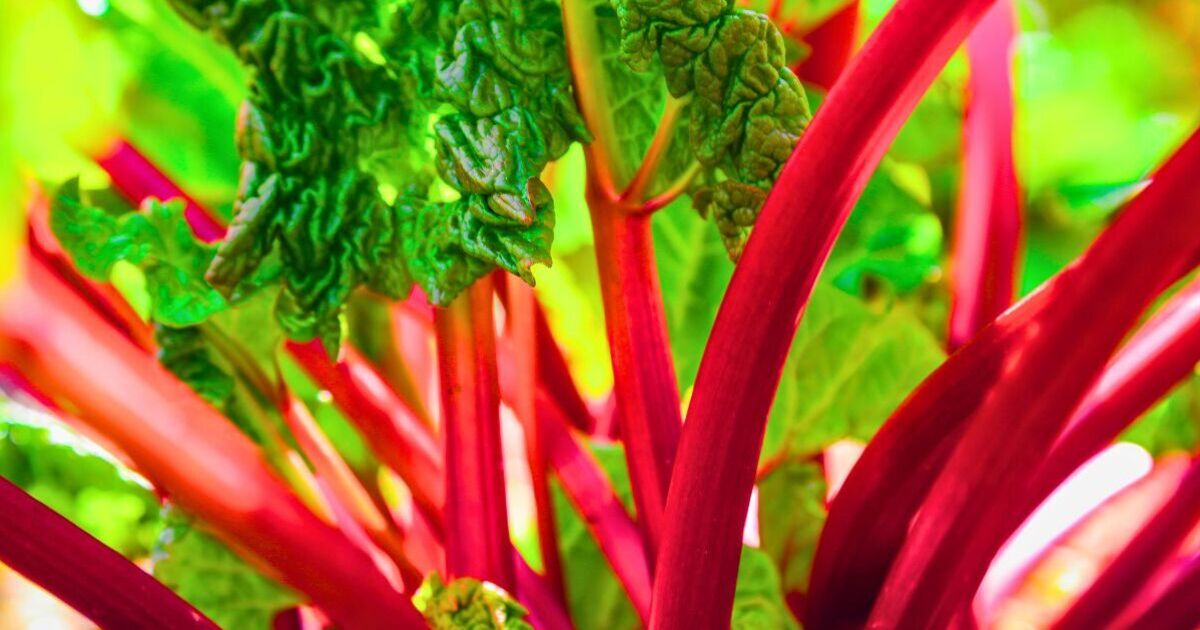
Rhubarb is one of the easiest crops to grow in a garden, as it can survive in freezing cold temperatures and usually only needs to be watered occasionally to stay healthy. However, if left alone, rhubarb will take ages to grow, and you will be waiting until April to be able to harvest this hardy crop. Leaving rhubarb in the ground for too long will also result in a less concentrated flavour, so it will not be as tasty as it could be if you take the time to prepare it properly.
Benedict Vanheems, a gardener from Grow Veg, has shared you get sweeter and juicier stalks in half the time if you try out a gardening method called forcing. He said: “Growing plants in the dark, often with the addition of a little warmth, is known as ‘forcing’. It’s a simple way of tricking nature into early growth. And the results are sublime.”
Why should you force rhubarb?
Forcing rhubarb is a simple technique in which you cover the plant, so no light reaches it. Sunlight will trigger the plant to photosynthesise, which causes it to grow bigger leaves, making it more fibrous and taking energy out of the stalks.
However, the leaves in rhubarb are poisonous and cannot be eaten, so there is no point letting the plant focus all its energy on the leaves.
If you force rhubarb, it will pull less water and sugar to feed the leaves, which gives the stalks a more concentrated flavour.
It will result in much bigger and tender rhubarb stalks, and if forced in mid-January, they can be ready to eat as early as next month.
How do you force rhubarb?
All you need are some big bell-shaped pots, and you can usually buy forcer pots online or at your local gardening centre.
Simply cover the rhubarb with the clay pot, and it will have a lid so you can check on the plant whenever you need to.
Next, cover the area around the pot with straw or compost to keep the rhubarb consistently warm and protect it from the strong winds that typically occur at this time of year.
The stems will usually be ready after two to four weeks of being covered, and you can harvest them by gently twisting and pulling.
The only thing to keep in mind is not to disturb the rhubarb crown, as this is where the plant stores its energy. Cutting or moving it can seriously damage, or even kill, the rhubarb.
If you cover the rhubarb and leave the crown undisturbed, you will be able to enjoy sweet, tender stalks throughout the rest of winter and into spring.
