


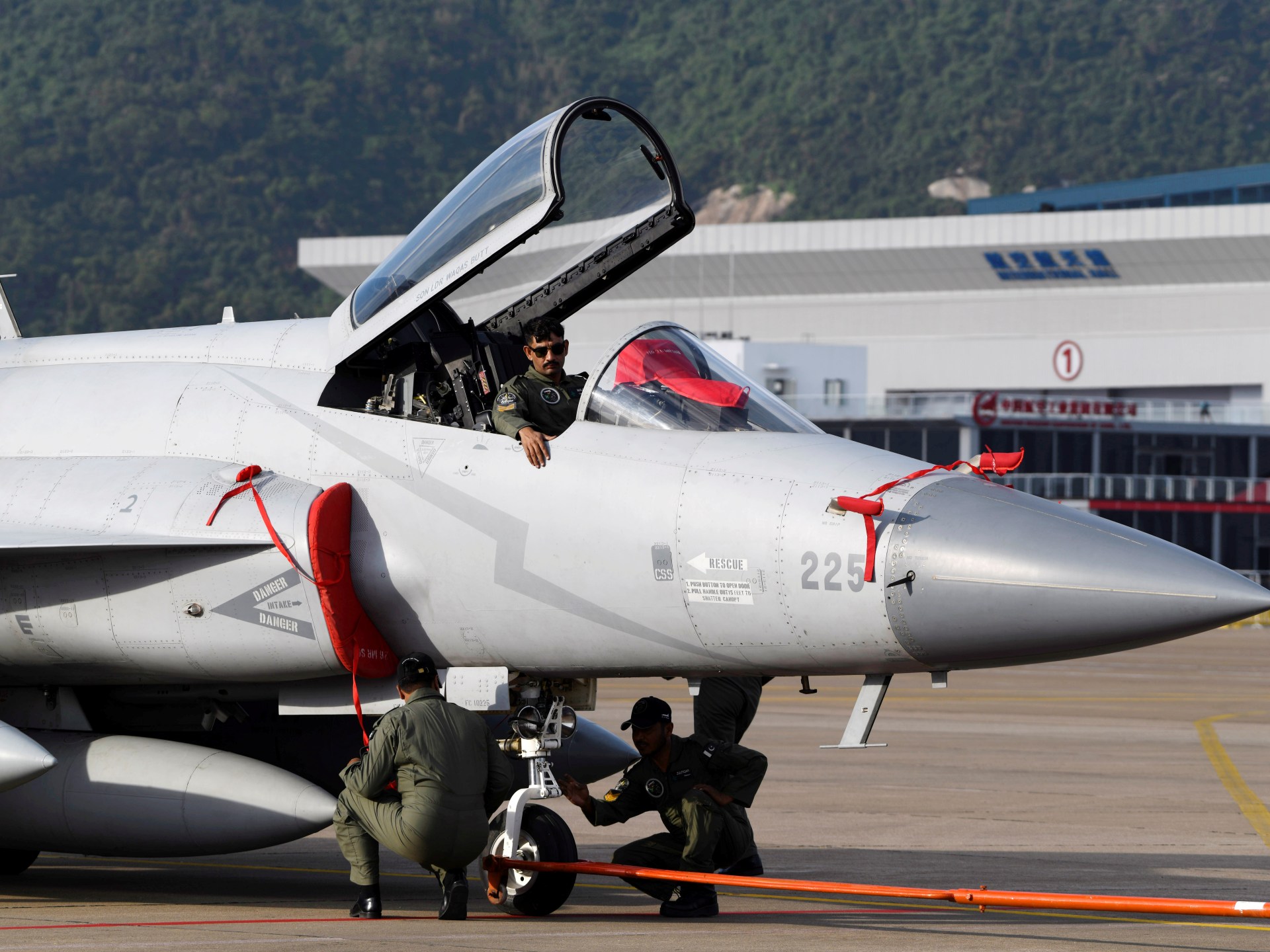
Islamabad, Pakistan – By the standards of mega arms deals, the $1.5bn deal for Pakistan to reportedly sell jets and weapons to Sudan’s military isn’t huge.
But the deal, which the Reuters news agency reported in early January was close to being finalised, could prove pivotal in the grinding war that has devoured Sudan for nearly three years between the country’s armed forces and the paramilitary Rapid Support Forces (RSF).
Recommended Stories
list of 4 itemsend of list
Tens of thousands of people have been killed, millions have been displaced, and RSF troops have been accused of gang rapes – including of infants.
The agreement under negotiation is only the latest in a series of moves by Pakistan in recent months that demonstrate the growing footprint of its military hardware and clout in the Arab world.
Pakistan’s military has, over the past few years, sold jets to multiple countries in Asia and Africa, and is in talks with others. But in the Middle East, its military role has traditionally, for the most part, involved training forces of Arab allies.
That’s now changing, with a spree of deals and negotiations that could turn Pakistan into a key security provider in some cases, and give it the ability to tip the balance in delicate conflicts in other instances.
But analysts warn that divisions within the Arab world mean that Pakistan will need to tread carefully – or risk burning bridges with important partners.
Saudi mutual defence
Anchoring this shift in Pakistan’s military influence in the Arab world is the Strategic Mutual Defence Agreement (SMDA) the country signed with Saudi Arabia last September, weeks after Israel bombed Qatar, setting off concerns across the region over whether the United States – historically the security provider for several Gulf states – could be trusted.
Since then, Reuters reports that Saudi Arabia is among the countries that have also expressed interest in Pakistan’s JF-17 Thunder fighter jet.
Saudi Arabia, one of the world’s wealthiest countries, operates a large and sophisticated air force equipped primarily with US and European aircraft and is in the process of ordering at least 48 US-manufactured F-35 jets, considered among the most advanced fighter aircraft currently available.
But Adil Sultan, a former Pakistan Air Force air commodore, said Saudi Arabia may also be looking to diversify its defence suppliers amid shifting geopolitical dynamics.
Pakistan, as a traditional ally, and with the mutual defence treaty in place, is a “reliable partner” for Saudi Arabia. If Saudi Arabia buys JF-17s, it would “enhance interoperability of both the air forces and would be mutually beneficial”, he told Al Jazeera.
Amir Husain, a Texas-based defence technology analyst, agreed.
“With the SMDA between Pakistan and Saudi Arabia, it makes a lot of sense for there to be a degree of commonality in systems,” he said.
“Saudi Arabia is helping countries in the region, such as Libya, Somalia and Sudan, attain stability. The JF-17, and the Royal Saudi Air Force’s [RSAF] familiarity with this platform, can achieve these regional stabilisation aims,” Husain added.
The JF-17 attraction
Apart from Saudi Arabia, Iraq too has shown interest in the JF-17, according to Pakistan’s Inter-Services Public Relations (ISPR) – the military’s media arm.

The JF-17 Thunder is a lightweight, all-weather, multirole fighter jointly produced by the Pakistan Aeronautical Complex and China’s Chengdu Aircraft Corporation.
Production is split between the two countries, with 58 percent carried out in Pakistan and 42 percent in China. Pakistan produces the airframe, while China supplies the avionics.
The latest version, the Block 3 variant, is classified as a 4.5-generation fighter. It features air-to-air and air-to-surface capabilities, advanced avionics, an Active Electronically Scanned Array (AESA) radar, electronic warfare systems and the ability to fire beyond-visual-range missiles.
The AESA radar allows pilots to track multiple targets simultaneously and detect threats at longer distances, though the aircraft lacks the stealth characteristics of fifth-generation fighters.
According to Pakistan Air Force (PAF) sources, full assembly takes place in Pakistan, and the production line at the Kamra facility can manufacture between 20 and 25 aircraft annually.
Pakistan has marketed the JF-17 internationally for several years. Azerbaijan, Nigeria and Myanmar are currently among the aircraft’s operators. But analysts say interest in the jet has intensified since the brief but intense military confrontation between Pakistan and India last May.
During their four-day air conflict, both launched missiles and drones at each other’s territories, parts of Kashmir they administer, and military bases, after gunmen killed 26 civilians in Indian-administered Kashmir.
On the first night of fighting, on May 7, Pakistan claimed it had shot down several Indian aircraft using Chinese-made J-10 Vigorous Dragon jets.
The PAF deployed a 42-aircraft formation that included JF-17 Thunders and US-made F-16 Fighting Falcons against a 72-aircraft formation from the Indian Air Force. Indian officials initially denied any losses but later acknowledged that “some” planes had been lost.
With a relatively low-price tag of $25m to $30m per aircraft, the JF-17 has long been seen as an attractive option for air forces seeking a cost-effective solution – it is much cheaper than comparable aircraft produced by Western manufacturers.
Analysts say that its recent combat exposure has added to its appeal, as battle-tested performance often carries greater weight than price alone.
Al Jazeera sent queries to ISPR and the PAF seeking confirmation and details about the negotiations with different countries, but received no response.
Beyond Saudi Arabia and Iraq, reports suggest that Sudan’s upcoming deal with Pakistan also involves the JF-17. Pakistan, reports in December suggested, was also planning to sell these jets to Libyan rebels. Outside the Arab world, Bangladesh and Indonesia have also shown interest in the jets.
Walking a tightrope
But Pakistan’s expanding military clientele also means that the country will need to juggle competing interests, say analysts.
In Sudan, its weapons and jets will go to the armed forces, which are also supported by Saudi Arabia. Sudan, meanwhile, has accused the United Arab Emirates of financing and arming the paramilitary RSF – a charge the UAE has repeatedly rejected.
In Libya, Pakistan reportedly struck a $4bn deal in December with Khalifa Haftar, the rebel leader whose army controls a major chunk of the country’s north.
Sudan’s army – which Pakistan’s army is reportedly about to arm – has previously accused Haftar of helping the RSF. Meanwhile, Saudi Arabia and the UAE have been on opposing sides in Yemen in recent weeks, with Riyadh accusing Abu Dhabi of arming southern separatists. The UAE has denied those allegations.
Against that backdrop, it will not be easy for Pakistan to sell the same weapons systems to opposing sides, Umer Karim, an associate fellow at the Riyadh-based King Faisal Center for Research and Islamic Studies, told Al Jazeera.
Karim said that he also believed that the Pakistani jets that Saudi Arabia has reportedly shown interest in are also meant for the Sudanese military.
But Pakistani platforms, and the JF-17 in particular, offer other benefits, even to Sudan’s army and Libyan rebels, said Sultan, the former PAF officer. That the JF-17 is manufactured jointly with China gives it extra geopolitical heft, he pointed out.
“These countries may buy fewer numbers [than bigger countries] as per their requirement, but Pakistan may be seen as a most reliable source to acquire aircraft due to strong support from China,” he said.
Unlike Western weapons systems, jets like the JF-17 are also appealing to Global South militaries because of their “robustness, lower lifecycle cost, ease of maintenance, and rapid operationalisation”, another retired PAF official, who requested anonymity, told Al Jazeera. This official was involved with the JF-17 programme while in service.

Pakistan’s weapons exports
The JF-17 is driving a much wider weapons export push from Pakistan, say analysts.
A recent report by KTrade, a Karachi-based brokerage and research firm, said that Pakistan’s defence exports include not only fighter jets but also tanks, drones, armoured vehicles, naval systems and small arms.
The Stockholm International Peace Research Institute (SIPRI) says Pakistan remains one of the world’s largest arms importers, with most of its imports coming from China, while exporting less than $50m worth of arms annually.
However, data from Pakistan’s central bank shows that arms and ammunition exports jumped massively in the 2022 to 2023 fiscal year, rising from $13m to more than $400m.
While never officially acknowledged, the jump in figures is widely attributed to Pakistan supplying ammunition to Ukrainian forces fighting Russia since February 2022.
The reports of potential JF-17 sales come as Pakistan seeks to stabilise its economy and rebuild diplomatic momentum. Islamabad has recently improved ties with the United States while reinforcing partnerships with China, Saudi Arabia and Turkiye.
Pakistan is currently in its 25th International Monetary Fund programme, a $7bn loan spread over 37 months, underscoring its need for foreign inflows.
Defence Minister Khawaja Asif recently suggested that arms exports could ease that dependence. “Our aircraft have been tested, and we are receiving so many orders that Pakistan may not need the International Monetary Fund in six months,” he said in a television interview.
KTrade estimated that existing and potential JF-17 deals, including a $1.5bn contract with Azerbaijan from 2024 and possible sales to Saudi Arabia, Libya and Sudan, could generate up to $13bn, boosting Pakistan’s foreign reserves by as much as 82 percent.
Karim, however, remains unconvinced, noting that previous efforts to market the jet did not lead to major contracts.
“It is a bit strange that all of a sudden, and without that sort of intense official and institutional engagement, so many defence deals involving the JF-17 are being discussed,” he said.
“For now, one can say they’re meant to project the narrative of the Pakistani defence industrial complex and its indigenous weapon systems coming of age and attracting customers everywhere.”
Sultan attributed the renewed interest to lessons drawn from last year’s conflict with India, “where Chinese-sourced weapon systems have proven their efficacy against the advanced Western aircraft”.

A multipolar arms market
Pakistan’s discussions with potential weapons buyers are unfolding against a backdrop of intensifying competition between the United States and China, as many countries reassess defence procurement strategies in an increasingly polarised world.
The US remains the world’s largest arms exporter, accounting for 43 percent of global sales in 2024, according to SIPRI. China ranks fourth, with about a 6 percent share – nearly two-thirds of which goes to Pakistan.
The retired PAF official who spoke on condition of anonymity said any JF-17 sale should be seen as strategic diversification, not geopolitical defiance.
“This reflects a pragmatic shift toward multipolar defence procurement, where performance, combat credibility, cost and sovereignty matter more than legacy alignments,” he said.
Husain, the defence technology analyst, agreed, saying Pakistan was not competing directly with US manufacturers.
“The JF-17 is a tremendous aircraft, and there is room in many fleets for both platforms,” he said.
Uzair Younus, partner at The Asia Group, a Washington, DC-based geopolitical consulting firm, concurred, adding that the diversification is largely driven by a recognition that “Western defence supply chains will be strained for the foreseeable future”.
“I don’t see Washington, at least under [US President Donald] Trump, viewing these developments negatively,” Younus said. Countries like Saudi Arabia are likely to procure cutting-edge supplies from the West, and access to platforms like the JF-17 helps them bolster their capacity to do the regional security work that America wants them to do,” he told Al Jazeera.
