


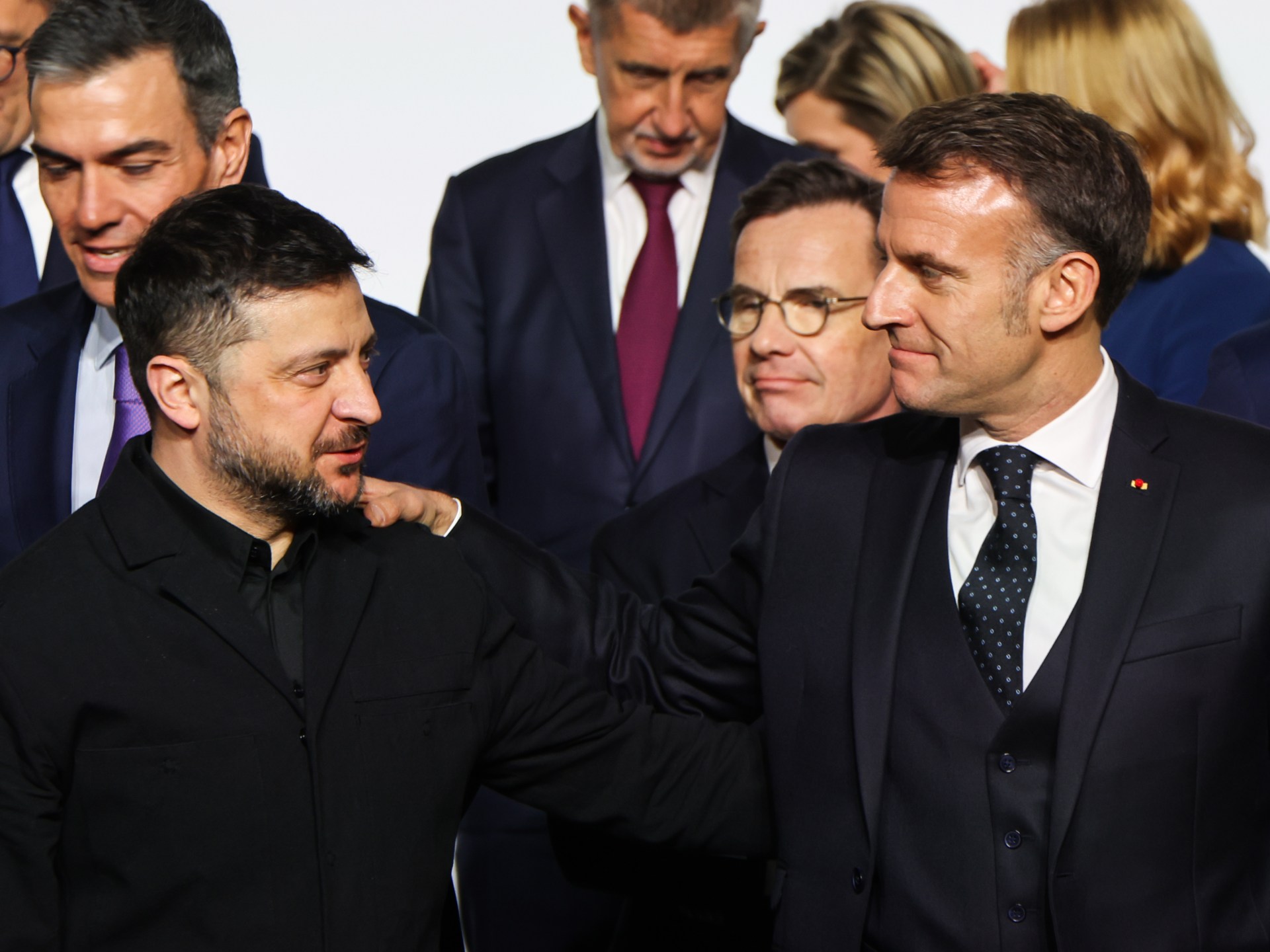
The United States has backed security guarantees for Ukraine, including leading a truce monitoring mechanism, as France and the United Kingdom pledged to deploy forces to Ukrainian territory if a ceasefire is reached with Russia.
The pledges came on Tuesday at a summit of the “Coalition of the Willing” in Paris, where representatives of 35 countries, including 27 heads of state or government, gathered to firm up post-war guarantees for Kyiv.
Recommended Stories
list of 4 itemsend of list
Russia annexed Crimea in 2014 and launched a full-scale invasion in 2022.
French President Emmanuel Macron said the “robust” guarantees would see the US lead a truce monitoring mechanism with European participation, alongside the deployment of a multinational European force.
Macron, Ukraine’s President Volodymyr Zelensky and United Kingdom’s Prime Minister Keir Starmer signed a declaration of intent after the talks, setting out the framework for such a deployment.
Macron said that Paris could contribute “several thousand” troops.
In a sign of closer transatlantic coordination, the summit was also attended by US envoys Steve Witkoff and Jared Kushner – President Donald Trump’s son-in-law – as well as Washington’s top general in Europe, Alexus Grynkewich. It marked the first time the US envoys had joined the coalition’s talks.
Witkoff, who has led talks with Russia, said that Trump “strongly stands behind security protocols” and that the guarantees are “important so that the people of Ukraine know that when this ends, it ends forever”.
He added, “Those security protocols are meant to a) deter any attacks, any further attacks in Ukraine. And b) if there are any attacks, they’re meant to defend and they will do both.”
Kushner called the Paris meeting “a very, very, big milestone”.
He said that if Ukrainians were to make a final deal “they have to know that after a deal they are secure, they have, obviously, a robust deterrence, and there’s real backstops to make sure that this will not happen again”.

The coalition said in a statement that the allies will participate in a proposed US-led ceasefire monitoring and verification mechanism, which officials said would likely involve drones, sensors and satellites, not US troops.
The coalition also agreed to establish a US-Ukraine-Coalition coordination cell in Paris and to continue supplying Kyiv’s front-line forces with equipment and training and back them up with air, land and sea support to deter any future Russian attack.
According to the statement, the post-ceasefire architecture would also include beefing up Ukraine’s war-battered army, including by replenishing its weapons stocks, so it could act as the country’s front-line deterrence against a resumption of fighting.
The allies said they must still finalise “binding commitments” setting out what they will do to support Ukraine.
The statement was not explicitly endorsed by the US and details of a US role were watered down from an earlier draft, notably removing language that outlined the use of US capabilities to support a multinational force in Ukraine.
But European officials hailed the involvement of the US envoys and their strong comments as evidence Washington stood behind the security framework.
Russia has yet to comment on the Paris meeting and has given no indication it would accept a settlement backed by foreign troops inside Ukraine — a condition it has previously rejected.
Moscow occupies about a fifth of Ukrainian territory and has not signalled a willingness to compromise, even as diplomatic efforts to end the war have intensified in recent months.
Starmer said the meeting made “excellent progress” but cautioned that “the hardest yards are still ahead,” noting that Russian attacks on Ukraine continue. He said peace would only be possible if Russia compromises.
In the event of a ceasefire, Starmer said the UK and France “will establish military hubs across Ukraine and build protected facilities for weapons and military equipment to support Ukraine’s defensive needs.”
Zelenskyy welcomed the promised security guarantees for Ukraine.
“It’s important that today the coalition has substantive documents. These are not just words. There is concrete content: a joint declaration by all the coalition countries and a trilateral declaration by France, Britain, and Ukraine,” he said.
He said the talks had “determined” which countries would take the lead on ensuring security and on reconstruction, as well as which forces were necessary and how they would be managed. He added the most significant issue still to be resolved was “the territorial question”, referring to Russian demands that Ukraine give up its eastern Donbas region.
Writing on Telegram after the meeting, Zelenskyy said the agreements were “a signal of how seriously Europe and the entire coalition of the willing are ready to work for real security”.
But he added that it remained to be determined how the monitoring would work and how the Ukrainian army would be supported and financed.
He went on to the US “for its readiness to be a backstop in all areas – security guarantees, monitoring a ceasefire and rebuilding”, and added the Ukrainian delegation would continue its talks on key issues on Wednesday.
Germany signalled a more cautious stance.
Chancellor Friedrich Merz said German forces could join to monitor a ceasefire but would be based in a neighbouring country. “We will certainly have to make compromises,” he said, adding that “we will not achieve textbook diplomatic solutions”.
Belgium said it would support the effort through its navy and air force, while Croatia and the Czech Republic said they would not deploy troops.
European leaders present at the meeting, including Macron, Starmer, Polish Prime Minister Donald Tusk and Italy’s Prime Minister Giorgia Meloni stressed that the statement showed renewed unity between Europe and the US on helping Ukraine.
Macron and Starmer brushed aside questions about whether they could rely on commitments by Trump, particularly given his renewed claims that the US should take over Greenland, an autonomous part of NATO ally Denmark.
