


This year marks three decades since the end of the war in Bosnia and Herzegovina, in which an estimated 100,000 people lost their lives. The war culminated in the Srebrenica genocide in July 1995, in which the Bosnian Serb forces, led by General Ratko Mladić, known as the “Butcher of Bosnia”, massacred more than 8,000 men and boys in a United Nations-designated “safe area”.
In the following decades, the International Criminal Tribunal for the Former Yugoslavia heard hundreds of witnesses and sentenced dozens of high-ranking Bosnian Serb political and military leaders, including those convicted of genocide. Meanwhile, the state of Bosnia and Herzegovina and foreign donors put significant funds into the study, victim recovery and remembrance of the genocide.
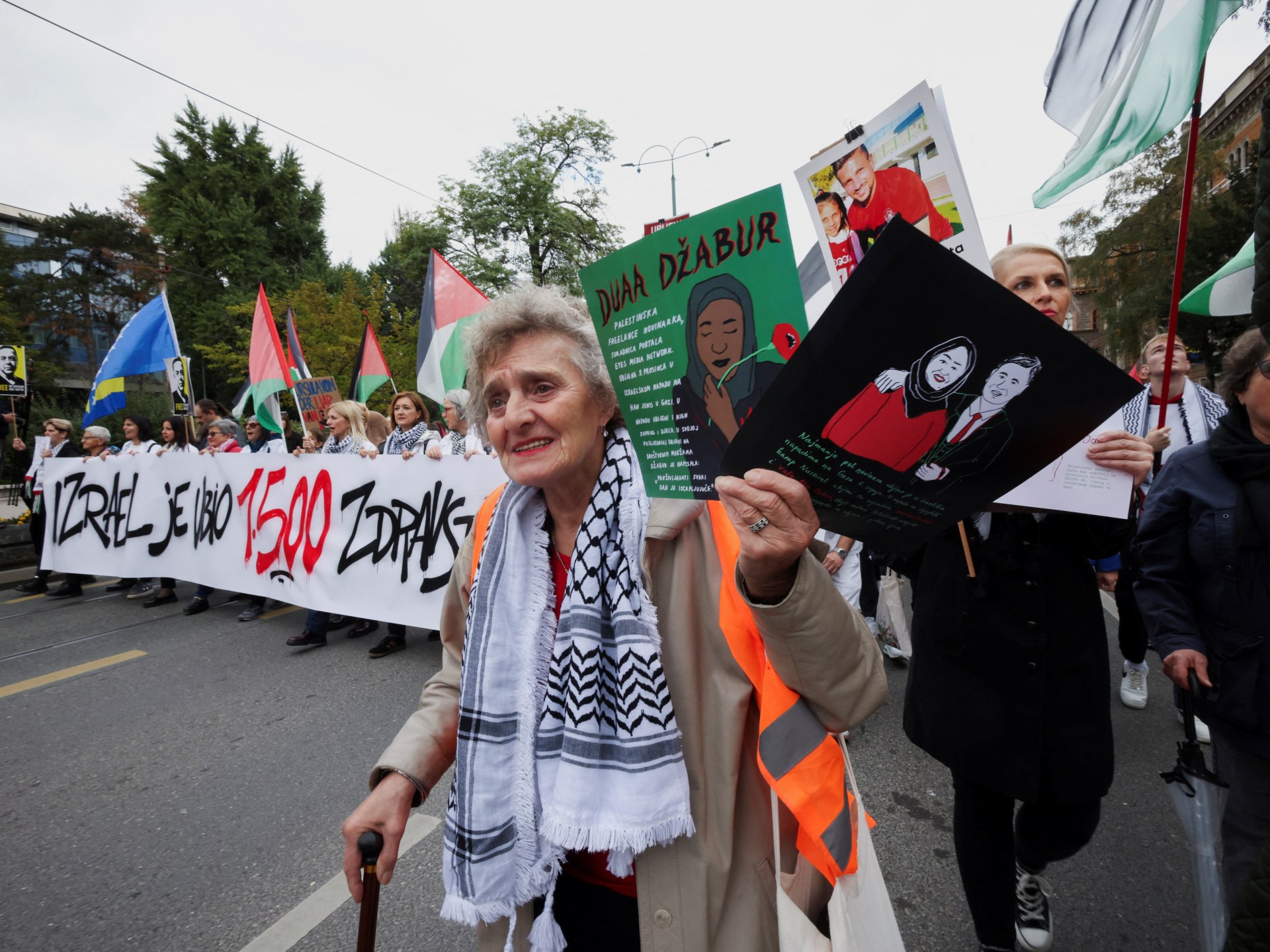
When the genocide in Gaza began, many Bosnians who survived the 1992-1995 war saw striking parallels between their own experiences and the suffering of Palestinians. Many took to the streets and spoke out against the genocidal war in Palestine.
However, many Bosnian intellectuals, especially those researching war crimes and genocide, have remained silent. Their refusal to speak out harms not just efforts to deliver justice for Gaza but also undermines the field of genocide studies.
Voices of conscience
Before we explore why Gaza has become such a taboo topic for Bosnian genocide scholars, it is important to point out that not all have remained silent. A relatively small group of Bosnian scholars who are not only academics but also active advocates for Palestine and human rights have chosen to speak up.
University professors and researchers, such as Lejla Kreševljaković, Sanela Čekić Bašić, Gorana Mlinarević, Jasna Fetahović, and Sanela Kapetanović have underscored that there is moral responsibility not to remain silent. They have led by example, participating in protests and speaking out in public.
Belma Buljubašić, a professor at the Faculty of Political Science at the University of Sarajevo, has criticised European and other political leaders who express sympathy for Srebrenica while justifying Israel’s actions in Gaza as acts of “self-defence”. Such double standards, she has argued, reveal a troubling pragmatism that undermines both solidarity and accountability.
In a recent interview, Edina Bećirević, a genocide scholar at the University of Sarajevo’s Faculty of Criminalistics, Criminology and Security Studies, said the genocide in Gaza clearly mirrors the dynamics seen in Srebrenica, defined by dehumanisation, ideological mobilisation and international complicity.
Ahmet Alibašić, the director of the Center for Advanced Studies and professor at the Faculty of Islamic Studies at the University of Sarajevo, has also been outspoken. Last year, he co-organised a seminar called From the Balkans to Gaza: A Critical Analysis of Genocide, which examined contemporary dynamics of mass violence through a “comparison between the Srebrenica genocide, the Sarajevo siege and the unfolding genocide in Gaza”.
Nidžara Ahmetašević, a Sarajevo-based journalist and media scholar, has also not hesitated to draw parallels between Gaza and the experiences of Bosnian survivors from besieged Sarajevo and Srebrenica.
For months, members of the Sarajevo Feminist Anti-Militarist Collective have been conducting demonstrations in downtown Sarajevo in which they read the names of children killed in Gaza, juxtaposing war crimes in the occupied Palestinian territory to Sarajevo’s own war horrors.
These individuals have all responded in various ways to the late Palestinian scholar Edward Said’s enduring exhortation that intellectuals must claim the space to speak truth to power, connect local memory to global justice and resist the politics of convenient truth-telling. Silence remains not a neutral stance but a political choice that sustains harm.
‘Not our battle’
Still, Said’s call has not stirred everyone to action. Paradoxically, many Bosnian genocide scholars have remained conspicuously silent, even as their colleagues abroad, among them Israeli genocide scholars Omer Bartov, Amos Goldberg and Shmuel Lederman, have publicly accused Israel of committing genocide in Gaza. This did not change even after the International Association of Genocide Scholars, the world’s largest academic body in the field, passed a resolution in August declaring that Israel’s actions in Gaza constitute a genocide.
Various experts on genocide at the University of Sarajevo’s Institute for Research of Crimes Against Humanity and International Law, lecturers at the Faculty of Law of the University of Sarajevo and genocide scholars at the Institute for Islamic Tradition of Bosniaks have been reluctant to comment on Israeli war crimes in Gaza.
As an institution, the Institute for Research of Crimes Against Humanity and International Law publicly addressed Gaza only after it was clear a ceasefire was soon to take effect. On October 8, it issued an evasive statement that did not mention Israel as the perpetrator of atrocities. This prompted some observers to accuse the institute, led by Muamer Džananović, of a calculated and opportunistic approach to the issue.
However, probably the most notable is the case of Emir Suljagić, genocide survivor and director of the Srebrenica Memorial Center. When asked about his stance on Gaza in late 2023, Suljagić told Haaretz: “This is not our battle.”
Many Bosnia-watchers swiftly condemned his remarks, pointing at the double standards of his position, given that just a year earlier Suljagić published an op-ed urging Ukrainians “not to lay down their arms”.
Furthermore, under his leadership, the Srebrenica Memorial Center produced a series of case studies funded by the United Kingdom government on Ukraine, Syria, South Sudan and Ethiopia, highlighting early warning signs of mass violence and genocide.
When the Palestinian community in Bosnia and Herzegovina expressed surprise over the lack of solidarity from Srebrenica with the people of Gaza, questioning whether the Srebrenica Memorial Center’s ties to the World Jewish Congress had something to do with its silence, Suljagić responded by accusing them of anti-Semitism.
He went even as far as to compare Hamas members to Chetniks, Serb nationalist and royalist forces that collaborated with German, Italian and at times Croatian fascists during World War II. Chetniks were responsible for some of the most brutal atrocities, including acts of genocide, against the Bosnian Muslim population. Almost half a century later, their enduring ideology fuelled war crimes and genocide against Bosniaks during the war in Bosnia.
The price of silence
The silence of many of Bosnia’s genocide scholars is not accidental. Some of them fear professional repercussions in Western academia and feel that accusing Israel of genocide would be unfavourable for their careers. Many are reluctant to jeopardise external financial support from foreign embassies, particularly funding provided by American, British and European Union donors to their projects and “side hustle” NGOs. Others are reluctant to alienate diplomatic partners who still wield influence over Bosnia’s fragile peace.
None of this, of course, justifies the silence of scholars working at institutions funded by Bosnian taxpayers rather than foreign donors. As genocide researchers whose work is sustained by public funds, they have an obligation to serve the public interest, which entails upholding scientific integrity, defending evidence-based genocide research and contributing to the global scholarly consensus without fear of professional repercussions.
When scholars, genocide researchers and lecturers at public institutions fail to speak out on war crimes or humanitarian crises, they contribute to legitimising a discourse that conceals harm. Such a discourse frames certain acts of mass violence as unworthy of the same scrutiny applied to other cases, creating a hierarchy of victimhood that serves political interests rather than universal principles and scholarly integrity.
Said’s universal call on intellectuals to speak out remains relevant and urgent. It reminds us that we need to move beyond comfortable silence, expose distortions of power and advocate for justice, transparency and accountability. In his view, silence is a form of complicity that undermines the very pursuit of truth that academia claims to uphold.
In this sense, public intellectuals must never allow themselves to slip into the realm of political bargaining where silence about one genocide is traded for recognition of another. If their advocacy becomes selective, then they risk turning genocide studies into a political tool. If that happens, genocide scholars will cease to be independent academics and instead become an interest group, stripped of the moral pedestal they so readily claim.
By foregrounding Gaza within the Bosnian context, we argue for a renewed ethic of intellectual responsibility and integrity, one that aligns scholarly discernment with public accountability and humane justice.
The views expressed in this article are the authors’ own and do not necessarily reflect Al Jazeera’s editorial policy.
